

The most effective way to increase water pressure in your house is to install a water pressure pump — also known as a booster pump — which actively draws water from your supply and delivers it to your taps, showers, and appliances at a consistently higher pressure. At Mawdsleys Pump Services, we specialise in the supply and installation of booster pumps and booster sets, delivering swift, reliable solutions every day.
What We'll Cover in This Guide
In this blog post, we’ll walk you through everything you need to know about low water pressure in your home. First, we’ll explore the most common reasons why your water pressure may be insufficient. Then, we’ll outline the practical solutions available — with a particular focus on how a water pressure pump (booster pump) can deliver a lasting, cost-effective fix. Finally, we’ve included a short FAQ to answer the questions we hear most often from homeowners.

Part 1: Why Is Your Water Pressure Not Sufficient?
Low water pressure is one of the most common complaints among UK homeowners. Before reaching for a solution, it’s important to understand the root cause. Here are the most likely reasons your pressure is falling short.
1. Your Mains Supply Pressure Is Too Low
Ofwat, the water services regulator for England and Wales, sets a guaranteed minimum supply pressure of 7 metres static head (0.7 bar) at the underground communication pipe serving your property, and most water companies aim to deliver at least 1.0 bar at your property boundary [Ofwat 2026]. Additionally, under Section 65 of the Water Industry Act 1991, water suppliers are legally obliged to maintain a constant supply at sufficient pressure to reach the top floor of every building within their region [Water Industry Act 1991].
In areas with ageing infrastructure, high elevation, or dense populations, mains pressure can fall short of what modern households expect. If you live at the end of a long supply line, on a hill, or in a densely built area, your incoming mains pressure may simply be insufficient to meet the demands of a modern home.
How to check: Your water supplier is required to investigate and address supply pressure shortfalls. WaterSafe — the UK’s register of approved plumbers — advises that as a practical guide, your kitchen tap (as the first tap on the supply) should be capable of filling a 4.5-litre bucket in 30 seconds with all other appliances off [WaterSafe 2026].
2. Peak Demand on the Network
Water pressure across the mains network often fluctuates throughout the day. Peak demand periods — typically 6–9am and 5–8pm — can cause noticeable pressure drops, particularly in densely populated areas [Bristol Water 2026]. If your pressure is borderline, you’ll often feel it most during these hours.
3. Shared Supply Pipes
Some older properties — particularly terraced houses and converted flats — share a single supply pipe with neighbouring homes. When a neighbour draws water simultaneously, pressure in your home drops [Rosebourne Plumbing 2026]. This is a structural issue that a water pressure pump can directly resolve.
4. Partially Closed Stop Valves
Your internal stop valve (stopcock) must be fully open for water to flow freely. Following building work, renovations, or a leak repair, valves are sometimes left partially closed — one of the most common and most easily overlooked causes of low pressure [CIPHE 2023]. Partially closed stopcocks, blocked inline filters, corroded internal pipework, and faulty PRVs are free fixes you should check first.
5. Corroded, Scaled, or Undersized Pipework
Over time, pipes — particularly older lead or steel ones — can corrode internally, reducing their effective bore. In hard water areas, limescale deposits build up inside pipes, showerheads, and tap aerators, restricting flow [Grundfos 2024]. Older properties often use ½-inch supply pipes that restrict water flow, while newer properties may have 1-inch mains that deliver significantly better performance. In severe cases, corroded pipes may need to be replaced entirely, as cleaning alone is insufficient.
6. A Faulty or Incorrectly Set Pressure-Reducing Valve (PRV)
Many homes are fitted with a pressure-reducing valve (PRV) to protect internal pipework from damage caused by excessively high incoming pressure. If your PRV is faulty or set too conservatively, it will artificially reduce pressure throughout your home — even if your mains supply is perfectly adequate [Bristol Water 2026]. PRV faults are a frequently cited but often overlooked cause of whole-house pressure loss.
7. Leaks in the System
Even a minor underground or internal leak can significantly reduce water pressure. Water escaping before it reaches your taps means reduced flow everywhere else, and leaks also cause water waste and, over time, structural damage [Severn Trent 2026]. If your pressure has dropped suddenly and no other cause is apparent, a leak must be investigated promptly.
8. Your Property's Elevation
In a gravity-fed system, 1 bar of pressure is generated for every 10 metres of height between the water source and your tap — so 2 bar equates to 20 metres of head, and 3 bar to 30 metres [Tank Services 2022]. If your property is elevated relative to the local water main, or if you have multiple storeys, the upper floors will always receive lower pressure than the ground floor. This is a fundamental physical constraint that a booster pump is specifically designed to overcome.
Part 2: What Are the Solutions?
Once you’ve identified the likely cause, here are the available solutions — ranging from quick checks you can carry out yourself, to professional installations that deliver a permanent fix.
Quick Checks First (No Cost)
Before investing in equipment, run through these free checks:
- Open your stop valve fully. Locate your internal stopcock (usually under the kitchen sink) and ensure it is completely open.
- Clean showerheads and tap aerators. Remove limescale deposits using a proprietary descaler or a white vinegar soak [Grundfos UK 2024].
- Check for obvious leaks. Look under sinks, around cisterns, and along all visible pipework.
- Contact your water supplier. If neighbours on your street are also affected, the problem may lie with the mains supply. Under the Water Industry Act 1991, your water supplier must investigate failures to meet the minimum pressure standard.
Have Your PRV Inspected
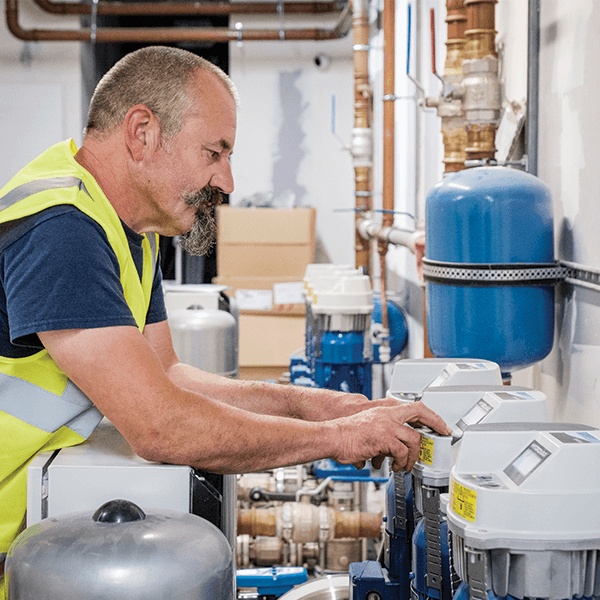
If you have a pressure-reducing valve fitted, have a qualified engineer inspect and calibrate it. A PRV set too low will throttle pressure across your entire home. This is a relatively inexpensive fix that can produce an immediate improvement.
Pipe Replacement
If your home has old, corroded, or undersized pipework, replacement is sometimes the only long-term solution. While this is the most disruptive and costly option, it restores full flow capacity and eliminates the risk of further blockage. Modern materials such as copper or cross-linked polyethylene (PEX) are highly durable and minimise future build-up [WarmZilla 2025]. Note that some buildings have pipes too narrow for a booster pump to work efficiently, even after installation — in those cases, pipe replacement may be a prerequisite.
Installing a Water Pressure Pump (Booster Pump) — The Most Effective Long-Term Solution
For homeowners where the cause is low mains pressure, shared supply pipes, or elevation — and where pipe condition is otherwise sound — installing a water pressure pump, commonly referred to as a booster pump, is the most reliable, efficient, and cost-effective permanent solution.
How a Booster Pump Works
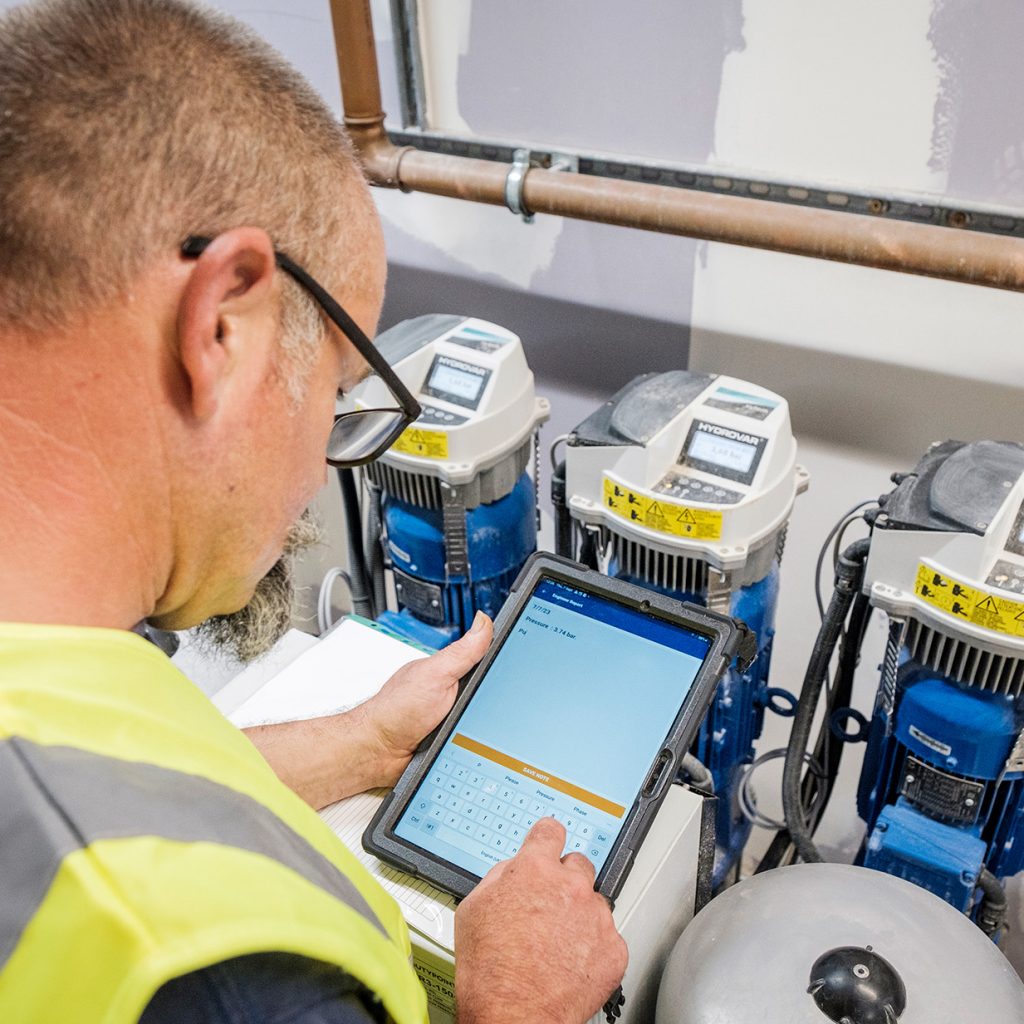
A water pressure pump (booster pump) draws water from a break tank and pushes it through your system at a higher, consistent pressure. Installed directly onto a cold water storage tank which is fed by your incoming cold water main, the pump activates automatically when it detects reduced flow or pressure, and switches off when demand stops — ensuring energy-efficient, on-demand performance with no manual intervention required.
As Grundfos — one of the world’s leading pump manufacturers — explains, booster pumps are specifically designed to increase water pressure and flow rate where the existing supply cannot meet household demand [Grundfos UK 2024].
What the Installation Involves
Under the Water Supply (Water Fittings) Regulations 1999, booster pumps capable of drawing more than 12 litres per minute cannot be connected directly to the mains supply — doing so would risk damaging the wider network and is illegal. Additionally, any booster set drawing more than 12 L/min must be formally declared to your local water company [Dutypoint 2026].
The correct and compliant installation method involves two components:
- A break tank, which fills from the mains via a float valve and provides a dedicated, regulated water source for the pump. For flats and small homes, a break tank of 125–150 litres is often sufficient; larger houses typically require 200–250 litres.
- The booster pump itself, which draws from the break tank and delivers pressurised water throughout the property.
The system typically installs in a utility room, under-stair cupboard, or garage. A WRAS-approved (Water Regulations Advisory Scheme) booster pump and break tank must be used for any installation connected to the mains supply [Dutypoint 2026]. Booster systems must be installed by a qualified plumber or heating engineer to meet UK water regulations and ensure proper operation.
Important installation note: Never install a booster pump directly onto copper pipework without a flex connector. Vibration from the pump transfers to the copper pipes and creates excessive noise. A qualified installer will account for this as standard.
Whole-House vs Single-Outlet Solutions vs Apartment Blocks
There are two primary configurations:
- Whole Apartment Block sets — delivery consistent pressure to every property and using an invertor ramps up and down depending on demand. Often Twin, Three, or Four Booster sets are set up in different configurations. Sometimes referred to as a duty assistant. Leading examples are Grundfos, Lowara, DAB, Wilo, Ebara.
- Whole-house booster sets deliver consistent pressure to every tap, shower, and appliance throughout the property. These are the most comprehensive solution and are ideal where low pressure affects multiple outlets. Leading examples used in UK homes include the Grundfos SCALA2, DAB Esybox, and Wilo Isar BOOST5
- Single-outlet booster pumps address pressure issues at one specific appliance or fixture — a shower in a top-floor bathroom, for example. These are more compact and lower cost, but do not resolve system-wide pressure deficiencies. Examples include the Stuart Turner Mainsboost Flomate and Salamander HomeBoost.
At Mawdsleys Pump Services, we specialise in the full range of booster pump and booster set configurations, and we’ll recommend the right solution for your specific property and usage profile.

The Benefits of a Booster Pump Installation
Once installed, a water pressure pump delivers immediate and lasting improvements
- Consistent shower pressure, even when other appliances are running simultaneously
- Faster filling of baths, washing machines, and dishwashers
- Better performance from combi boilers, which often require a minimum inlet pressure to operate correctly
- Improved water flow to upper floors, eliminating the pressure drop between ground and first or second floor
- Automatic, silent operation with no manual switching required
Pressure ceiling: Water pressure inside the home must not exceed 4 bar (60 psi), as pressures above this level can damage internal pipework and fittings. A correctly specified booster pump and PRV will ensure your system stays within safe limits.
Leading pump manufacturers trusted by Mawdsleys Pump Services include Grundfos, Lowara, DAB and Ebara— all of which produce WRAS-approved booster pumps that comply fully with UK water regulations.
How Mawdsleys Pump Services Can Help
At Mawdsleys Pump Services, we are booster pump and booster set specialists. Our value proposition is simple: Reliable, Rapid, Informative — we deliver swift solutions for your pump equipment every day.
Whether you need expert advice on the right water pressure pump for your home or Apartment block , a fully compliant installation, or 24/7 support following an emergency, our team is ready to help. We’re proud of our consistently strong Google Reviews, which reflect our commitment to speed of service and precise, honest communication at every stage.
If you’re experiencing low water pressure, don’t put up with it any longer. Contact Mawdsleys Pump Services today for a prompt, professional assessment.
What pressure should the water supply to my home be?
In England and Wales, Ofwat requires water suppliers to maintain a guaranteed minimum of 0.7 bar (7 metres static head) at the communication pipe. In practice, most water companies aim to deliver at least 1.0 bar to your property boundary [Ofwat 2025]. Anything consistently below 1 bar is considered low pressure and is worth investigating.
Can I connect a booster pump directly to my mains supply?
No. Under the Water Supply (Water Fittings) Regulations 1999, it is illegal to connect a pump drawing more than 12 litres per minute directly to the mains supply. A correctly installed booster pump must draw from a break tank fed from the mains. This protects the wider water network and ensures your installation is fully compliant.
Will a booster pump work with my combi boiler?
A combi boiler requires adequate mains inlet pressure to function correctly. If your boiler is underperforming due to low incoming pressure, a water pressure pump installed upstream of the boiler can often resolve the issue. We recommend consulting a qualified engineer to confirm compatibility with your specific boiler model.
How much does a booster pump installation cost?
Costs vary depending on the size and specification of the pump, the complexity of the installation, and whether a break tank is required. As booster pump specialists, Mawdsleys Pump Services offers competitive, transparent pricing and will provide a clear quote before any work begins.
How do I know if my low pressure is caused by the mains or by my own pipework?
A good starting point is to contact your water supplier and ask them to measure the pressure at your property boundary. If pressure at the boundary is within the required range but is low inside your home, the issue lies within your own pipework — and a booster pump or internal investigation is the appropriate next step. A qualified pump engineer can carry out a full diagnostic assessment.
How long does a booster pump last?
A quality booster pump from a reputable manufacturer — such as Grundfos, Lowara, or DAB — typically lasts between 8 and 15 years with proper installation and routine maintenance. Regular servicing is recommended to maintain peak performance and identify any wear before it becomes a problem.
Is 24/7 support available if my booster pump fails?
Yes. Mawdsleys Pump Services offers 24/7 support. We understand that a loss of water pressure is not a problem that can wait — and our team is available around the clock to provide rapid, reliable assistance.
Booster Pump FAQs
References
Ofwat, 2026, The guaranteed standards scheme (GSS) summary of standards and conditions, https://www.ofwat.gov.uk/wp-content/uploads/2026/02/The-guaranteed-standards-scheme-GSS-summary-of-standards-and-conditions-June-2026.pdf
Water Industry Act 1991, https://www.legislation.gov.uk/ukpga/1991/56/contentshttps://www.watersafe.org.uk/advice/common_plumbing_questions1/pressure/what_is_the_minimum_water_pressure_that_a_water_supplier_must_supply/
WaterSafe, 2026, What is the minimum water pressure that a water supplier must supply?, https://www.watersafe.org.uk/advice/common_plumbing_questions1/pressure/what_is_the_minimum_water_pressure_that_a_water_supplier_must_supply/
Bristol Water, 2026, What to do if you have a problem with water pressure, https://www.bristolwater.co.uk/home/account-and-services/water-pressure-management
Rosebourne Plumbing, 2026, Low Water Pressure?, https://rosebourneplumbing.co.uk/blog/low-water-pressure-guide-causes-solutions-uk
CIPHE, 2023, Summer DIY: Dos and Don’ts, https://www.ciphe.org.uk/news-and-advice/press-releases/summer-diy/
Grundfos, 2024, Why is my water pressure low? A guide for homeowners, https://www.grundfos.com/uk/learn/research-and-insights/why-is-my-water-pressure-low-a-guide-for-homeowners
Bristol Water, 2026, Your Water, https://www.bristolwater.co.uk/faq-individual-0
Severn Trent, 2026, Our customer guide to our water pressure policy, https://www.stwater.co.uk/help-and-contact/customer-information/customer-guide-to-our-water-pressure-policy/
Tank Services, 2022, How to Boost Water Pressure: Expert Guide for Homes and Businesses, https://www.tankservices.co.uk/blog/how-to-increase-or-boost-water-pressure
WarmZilla, 2025, What causes low water pressure in my home, https://www.warmzilla.co.uk/blog/what-causes-low-water-pressure-in-my-home
The Water Supply (Water Fittings) Regulations 1999, https://www.legislation.gov.uk/uksi/1999/1148/contents
Dutypoint, 2025, Dutypoint’s Guide to Water Pressure in London and How to Solve It, https://www.dutypoint.com/water-pressure-in-london/