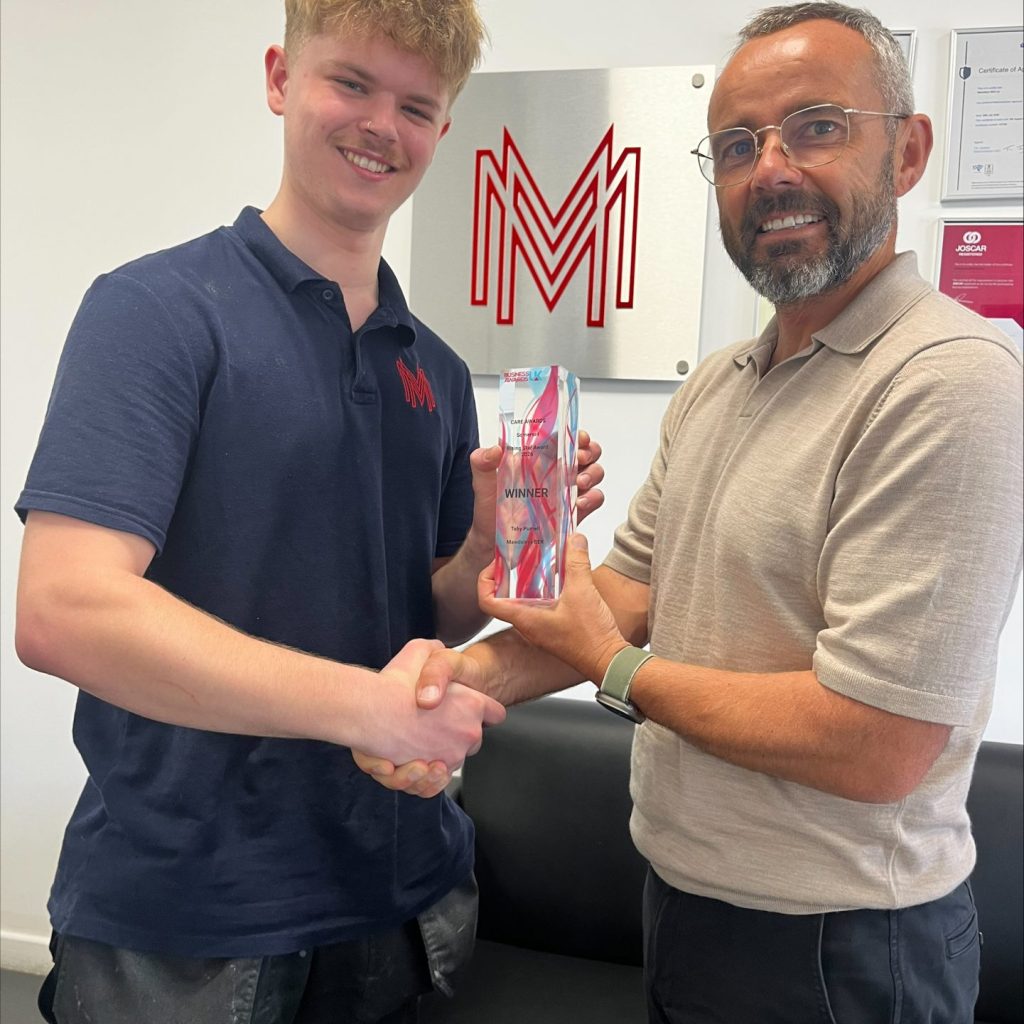
Say Hello to Chris – Our New Technical M&E Sales Manager!

We’ve got some brilliant news to share – we’ve welcomed Chris to the Mawdsleys Pump Services team as our new Technical M&E Sales Manager, and honestly, we couldn’t be happier to have him on board!

So, who is Chris?

Chris joins us with a seriously impressive background. He’s got a Mechanical Engineering Degree (2:1 with Honours) from Brunel University under his belt, and since then he’s built up a wealth of experience in account and contract management across the industry. Most recently, he was working as a Key Account Manager for a renowned name in the industry.

What does he specialise in?

Chris is an expert when it comes to industrial motors, pumps and gearboxes. Whether it’s sourcing and specifying new kit, quoting repairs, or sorting out an urgent breakdown, he’s done it all across a huge range of industries throughout the South West. That kind of hands-on, practical experience is exactly what our customers benefit from, and we’re thrilled to have that expertise strengthening our team.

Getting to know Chris outside of work

It’s been a massive year for Chris – he and his partner welcomed their first child, who’s just about to turn 6 months old, and on top of that they’ve bought a house which they’re busy doing up. Talk about a lot going on at once!

When he’s not chasing after a toddler or knee-deep in DIY, you’ll find Chris on the rugby pitch. He’s a big Exeter Chiefs fan and plays tag rugby twice a week. He’s also a regular at the gym and loves getting out for food with friends in Bristol – he reckons there’s just so much choice there.

Music-wise, Chris is into Blink 182, Sam Fender, Rage Against The Machine and Red Hot Chili Peppers – though like most of us, he admits he’s recently fallen down the Country music rabbit hole thanks to Spotify DJ Mode!

And if you really want to win him over, offer him a tiramisu or a slice of Colin the Caterpillar cake.

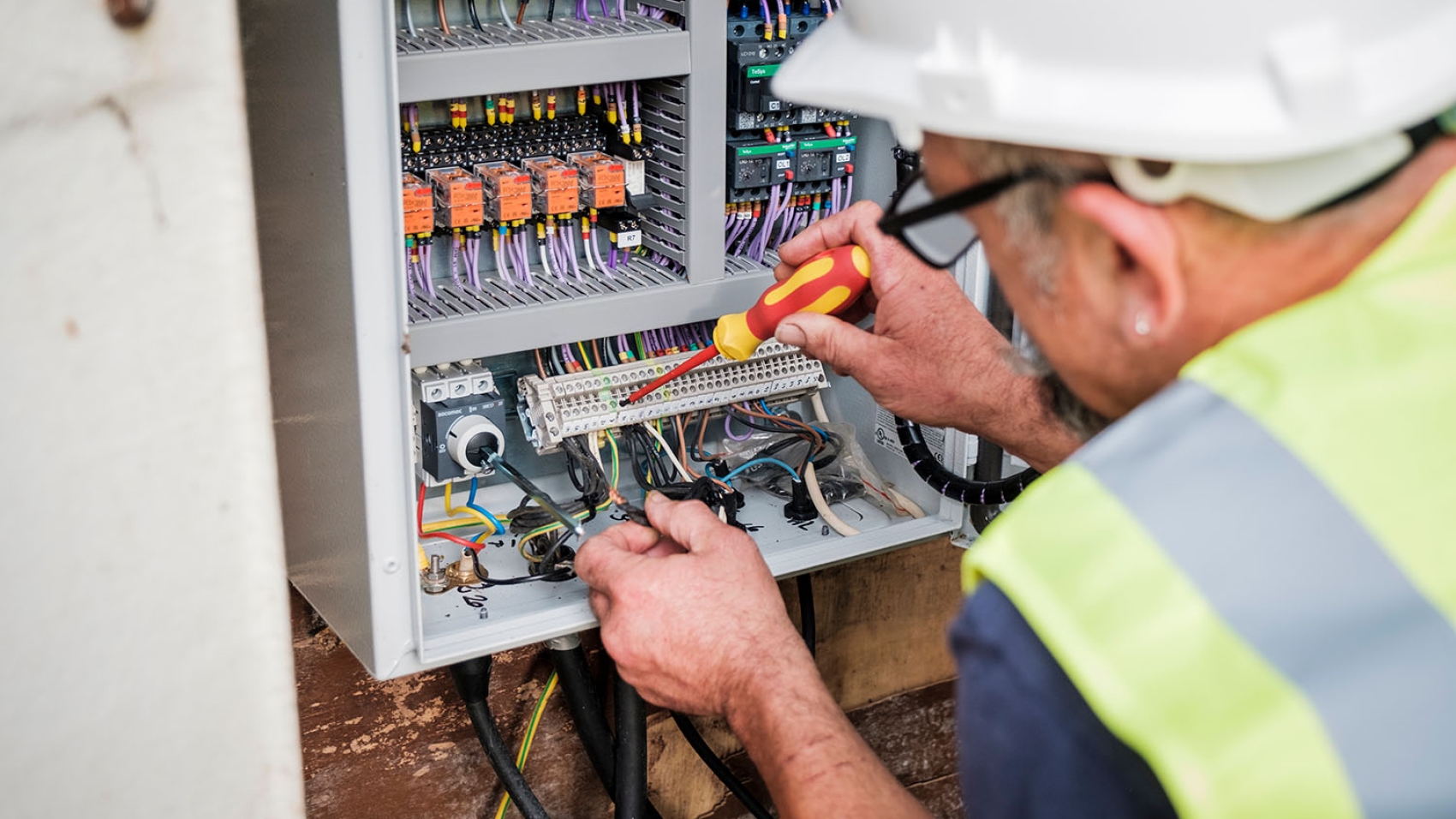
An image of an engineer programming a booster set

How to Increase Water Pressure in Your House?

The most effective way to increase water pressure in your house is to install a water pressure pump — also known as a booster pump — which actively draws water from your supply and delivers it to your taps, showers, and appliances at a consistently higher pressure. At Mawdsleys Pump Services, we specialise in the supply and installation of booster pumps and booster sets, delivering swift, reliable solutions every day.

What We'll Cover in This Guide

In this blog post, we’ll walk you through everything you need to know about low water pressure in your home. First, we’ll explore the most common reasons why your water pressure may be insufficient. Then, we’ll outline the practical solutions available — with a particular focus on how a water pressure pump (booster pump) can deliver a lasting, cost-effective fix. Finally, we’ve included a short FAQ to answer the questions we hear most often from homeowners.

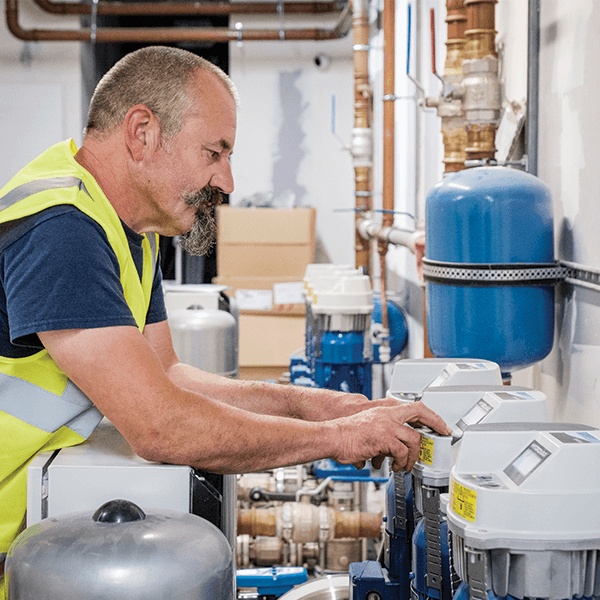
An image of booster set

Part 1: Why Is Your Water Pressure Not Sufficient?

Low water pressure is one of the most common complaints among UK homeowners. Before reaching for a solution, it’s important to understand the root cause. Here are the most likely reasons your pressure is falling short.

1. Your Mains Supply Pressure Is Too Low

Ofwat, the water services regulator for England and Wales, sets a guaranteed minimum supply pressure of 7 metres static head (0.7 bar) at the underground communication pipe serving your property, and most water companies aim to deliver at least 1.0 bar at your property boundary [Ofwat 2026]. Additionally, under Section 65 of the Water Industry Act 1991, water suppliers are legally obliged to maintain a constant supply at sufficient pressure to reach the top floor of every building within their region [Water Industry Act 1991].

In areas with ageing infrastructure, high elevation, or dense populations, mains pressure can fall short of what modern households expect. If you live at the end of a long supply line, on a hill, or in a densely built area, your incoming mains pressure may simply be insufficient to meet the demands of a modern home.

How to check: Your water supplier is required to investigate and address supply pressure shortfalls. WaterSafe — the UK’s register of approved plumbers — advises that as a practical guide, your kitchen tap (as the first tap on the supply) should be capable of filling a 4.5-litre bucket in 30 seconds with all other appliances off [WaterSafe 2026].

2. Peak Demand on the Network

Water pressure across the mains network often fluctuates throughout the day. Peak demand periods — typically 6–9am and 5–8pm — can cause noticeable pressure drops, particularly in densely populated areas [Bristol Water 2026]. If your pressure is borderline, you’ll often feel it most during these hours.

3. Shared Supply Pipes

Some older properties — particularly terraced houses and converted flats — share a single supply pipe with neighbouring homes. When a neighbour draws water simultaneously, pressure in your home drops [Rosebourne Plumbing 2026]. This is a structural issue that a water pressure pump can directly resolve.

4. Partially Closed Stop Valves

Your internal stop valve (stopcock) must be fully open for water to flow freely. Following building work, renovations, or a leak repair, valves are sometimes left partially closed — one of the most common and most easily overlooked causes of low pressure [CIPHE 2023]. Partially closed stopcocks, blocked inline filters, corroded internal pipework, and faulty PRVs are free fixes you should check first.

5. Corroded, Scaled, or Undersized Pipework

Over time, pipes — particularly older lead or steel ones — can corrode internally, reducing their effective bore. In hard water areas, limescale deposits build up inside pipes, showerheads, and tap aerators, restricting flow [Grundfos 2024]. Older properties often use ½-inch supply pipes that restrict water flow, while newer properties may have 1-inch mains that deliver significantly better performance. In severe cases, corroded pipes may need to be replaced entirely, as cleaning alone is insufficient.

6. A Faulty or Incorrectly Set Pressure-Reducing Valve (PRV)

Many homes are fitted with a pressure-reducing valve (PRV) to protect internal pipework from damage caused by excessively high incoming pressure. If your PRV is faulty or set too conservatively, it will artificially reduce pressure throughout your home — even if your mains supply is perfectly adequate [Bristol Water 2026]. PRV faults are a frequently cited but often overlooked cause of whole-house pressure loss.

7. Leaks in the System

Even a minor underground or internal leak can significantly reduce water pressure. Water escaping before it reaches your taps means reduced flow everywhere else, and leaks also cause water waste and, over time, structural damage [Severn Trent 2026]. If your pressure has dropped suddenly and no other cause is apparent, a leak must be investigated promptly.

8. Your Property's Elevation

In a gravity-fed system, 1 bar of pressure is generated for every 10 metres of height between the water source and your tap — so 2 bar equates to 20 metres of head, and 3 bar to 30 metres [Tank Services 2022]. If your property is elevated relative to the local water main, or if you have multiple storeys, the upper floors will always receive lower pressure than the ground floor. This is a fundamental physical constraint that a booster pump is specifically designed to overcome.

Part 2: What Are the Solutions?

Once you’ve identified the likely cause, here are the available solutions — ranging from quick checks you can carry out yourself, to professional installations that deliver a permanent fix.

Quick Checks First (No Cost)

Before investing in equipment, run through these free checks:

  • Open your stop valve fully. Locate your internal stopcock (usually under the kitchen sink) and ensure it is completely open.
  • Clean showerheads and tap aerators. Remove limescale deposits using a proprietary descaler or a white vinegar soak [Grundfos UK 2024].
  • Check for obvious leaks. Look under sinks, around cisterns, and along all visible pipework.
  • Contact your water supplier. If neighbours on your street are also affected, the problem may lie with the mains supply. Under the Water Industry Act 1991, your water supplier must investigate failures to meet the minimum pressure standard.
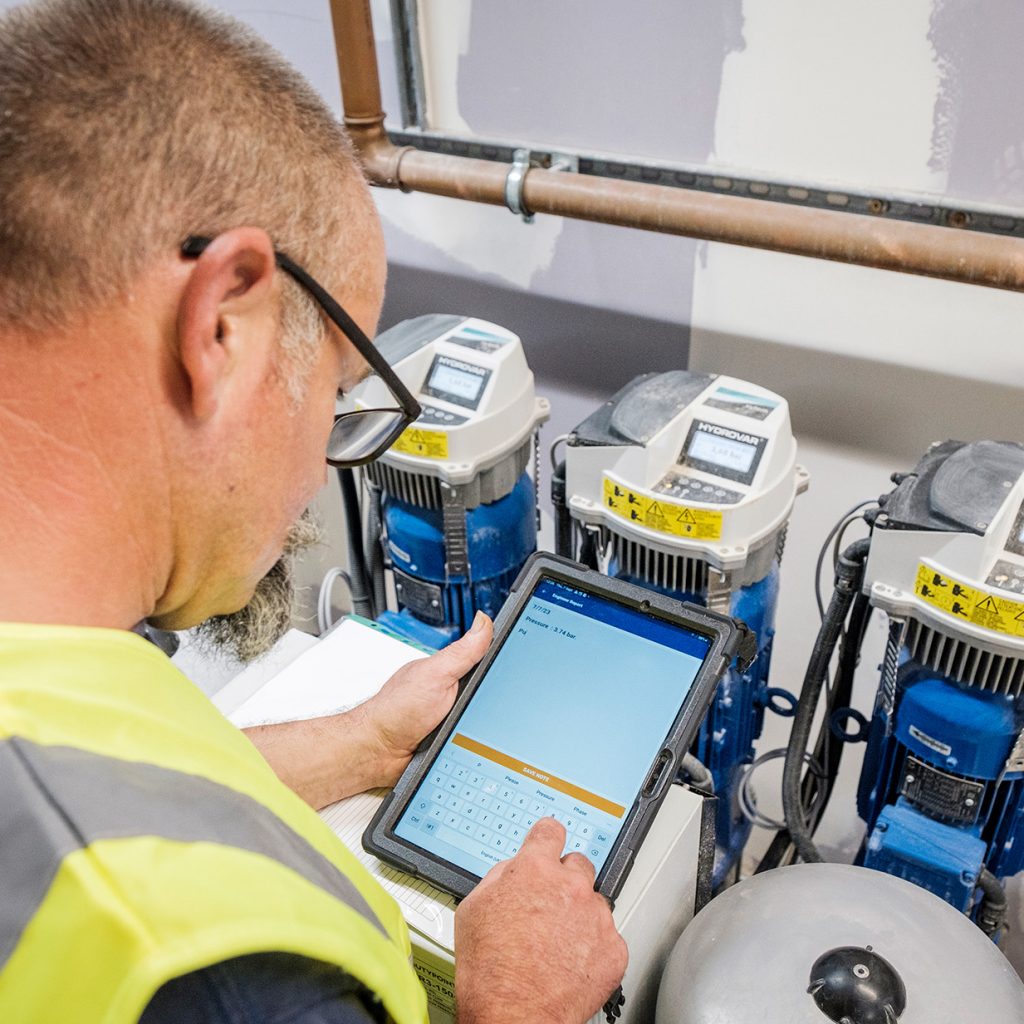
An image of an engineer programming a booster set

Have Your PRV Inspected

If you have a pressure-reducing valve fitted, have a qualified engineer inspect and calibrate it. A PRV set too low will throttle pressure across your entire home. This is a relatively inexpensive fix that can produce an immediate improvement.

Pipe Replacement

If your home has old, corroded, or undersized pipework, replacement is sometimes the only long-term solution. While this is the most disruptive and costly option, it restores full flow capacity and eliminates the risk of further blockage. Modern materials such as copper or cross-linked polyethylene (PEX) are highly durable and minimise future build-up [WarmZilla 2025]. Note that some buildings have pipes too narrow for a booster pump to work efficiently, even after installation — in those cases, pipe replacement may be a prerequisite.

Installing a Water Pressure Pump (Booster Pump) — The Most Effective Long-Term Solution

For homeowners where the cause is low mains pressure, shared supply pipes, or elevation — and where pipe condition is otherwise sound — installing a water pressure pump, commonly referred to as a booster pump, is the most reliable, efficient, and cost-effective permanent solution.

One of our engineer working on a booster set

How a Booster Pump Works

A water pressure pump (booster pump) draws water from a break tank and pushes it through your system at a higher, consistent pressure. Installed directly onto a cold water storage tank which is fed by your incoming cold water main, the pump activates automatically when it detects reduced flow or pressure, and switches off when demand stops — ensuring energy-efficient, on-demand performance with no manual intervention required.

As Grundfos — one of the world’s leading pump manufacturers — explains, booster pumps are specifically designed to increase water pressure and flow rate where the existing supply cannot meet household demand [Grundfos UK 2024].

What the Installation Involves

Under the Water Supply (Water Fittings) Regulations 1999, booster pumps capable of drawing more than 12 litres per minute cannot be connected directly to the mains supply — doing so would risk damaging the wider network and is illegal. Additionally, any booster set drawing more than 12 L/min must be formally declared to your local water company [Dutypoint 2026].

The correct and compliant installation method involves two components:

  • A break tank, which fills from the mains via a float valve and provides a dedicated, regulated water source for the pump. For flats and small homes, a break tank of 125–150 litres is often sufficient; larger houses typically require 200–250 litres.
  • The booster pump itself, which draws from the break tank and delivers pressurised water throughout the property.

The system typically installs in a utility room, under-stair cupboard, or garage. A WRAS-approved (Water Regulations Advisory Scheme) booster pump and break tank must be used for any installation connected to the mains supply [Dutypoint 2026]. Booster systems must be installed by a qualified plumber or heating engineer to meet UK water regulations and ensure proper operation.

Important installation note: Never install a booster pump directly onto copper pipework without a flex connector. Vibration from the pump transfers to the copper pipes and creates excessive noise. A qualified installer will account for this as standard.

Whole-House vs Single-Outlet Solutions vs Apartment Blocks

There are two primary configurations:

  • Whole Apartment Block sets — delivery consistent pressure to every property and using an invertor ramps up and down depending on demand. Often Twin, Three, or Four Booster sets are set up in different configurations.  Sometimes referred to as a duty assistant. Leading examples are Grundfos, Lowara, DAB, Wilo, Ebara.
  • Whole-house booster sets deliver consistent pressure to every tap, shower, and appliance throughout the property. These are the most comprehensive solution and are ideal where low pressure affects multiple outlets. Leading examples used in UK homes include the Grundfos SCALA2, DAB Esybox, and Wilo Isar BOOST5
  • Single-outlet booster pumps address pressure issues at one specific appliance or fixture — a shower in a top-floor bathroom, for example. These are more compact and lower cost, but do not resolve system-wide pressure deficiencies. Examples include the Stuart Turner Mainsboost Flomate and Salamander HomeBoost.

At Mawdsleys Pump Services, we specialise in the full range of booster pump and booster set configurations, and we’ll recommend the right solution for your specific property and usage profile.

The Benefits of a Booster Pump Installation

Once installed, a water pressure pump delivers immediate and lasting improvements

  • Consistent shower pressure, even when other appliances are running simultaneously
  • Faster filling of baths, washing machines, and dishwashers
  • Better performance from combi boilers, which often require a minimum inlet pressure to operate correctly
  • Improved water flow to upper floors, eliminating the pressure drop between ground and first or second floor
  • Automatic, silent operation with no manual switching required

Pressure ceiling: Water pressure inside the home must not exceed 4 bar (60 psi), as pressures above this level can damage internal pipework and fittings. A correctly specified booster pump and PRV will ensure your system stays within safe limits.

Leading pump manufacturers trusted by Mawdsleys Pump Services include Grundfos, Lowara, DAB and Ebara— all of which produce WRAS-approved booster pumps that comply fully with UK water regulations.

How Mawdsleys Pump Services Can Help

At Mawdsleys Pump Services, we are booster pump and booster set specialists. Our value proposition is simple: Reliable, Rapid, Informative — we deliver swift solutions for your pump equipment every day.

Whether you need expert advice on the right water pressure pump for your home or Apartment block , a fully compliant installation, or 24/7 support following an emergency, our team is ready to help. We’re proud of our consistently strong Google Reviews, which reflect our commitment to speed of service and precise, honest communication at every stage.

If you’re experiencing low water pressure, don’t put up with it any longer. Contact Mawdsleys Pump Services today for a prompt, professional assessment.

In England and Wales, Ofwat requires water suppliers to maintain a guaranteed minimum of 0.7 bar (7 metres static head) at the communication pipe. In practice, most water companies aim to deliver at least 1.0 bar to your property boundary [Ofwat 2025]. Anything consistently below 1 bar is considered low pressure and is worth investigating.

No. Under the Water Supply (Water Fittings) Regulations 1999, it is illegal to connect a pump drawing more than 12 litres per minute directly to the mains supply. A correctly installed booster pump must draw from a break tank fed from the mains. This protects the wider water network and ensures your installation is fully compliant.

A combi boiler requires adequate mains inlet pressure to function correctly. If your boiler is underperforming due to low incoming pressure, a water pressure pump installed upstream of the boiler can often resolve the issue. We recommend consulting a qualified engineer to confirm compatibility with your specific boiler model.

Costs vary depending on the size and specification of the pump, the complexity of the installation, and whether a break tank is required. As booster pump specialists, Mawdsleys Pump Services offers competitive, transparent pricing and will provide a clear quote before any work begins.

A good starting point is to contact your water supplier and ask them to measure the pressure at your property boundary. If pressure at the boundary is within the required range but is low inside your home, the issue lies within your own pipework — and a booster pump or internal investigation is the appropriate next step. A qualified pump engineer can carry out a full diagnostic assessment.

A quality booster pump from a reputable manufacturer — such as Grundfos, Lowara, or DAB — typically lasts between 8 and 15 years with proper installation and routine maintenance. Regular servicing is recommended to maintain peak performance and identify any wear before it becomes a problem.

Yes. Mawdsleys Pump Services offers 24/7 support. We understand that a loss of water pressure is not a problem that can wait — and our team is available around the clock to provide rapid, reliable assistance.

Booster Pump FAQs

References

Ofwat, 2026, The guaranteed standards scheme (GSS) summary of standards and conditions, https://www.ofwat.gov.uk/wp-content/uploads/2026/02/The-guaranteed-standards-scheme-GSS-summary-of-standards-and-conditions-June-2026.pdf

Water Industry Act 1991, https://www.legislation.gov.uk/ukpga/1991/56/contentshttps://www.watersafe.org.uk/advice/common_plumbing_questions1/pressure/what_is_the_minimum_water_pressure_that_a_water_supplier_must_supply/

WaterSafe, 2026, What is the minimum water pressure that a water supplier must supply?, https://www.watersafe.org.uk/advice/common_plumbing_questions1/pressure/what_is_the_minimum_water_pressure_that_a_water_supplier_must_supply/

Bristol Water, 2026, What to do if you have a problem with water pressure, https://www.bristolwater.co.uk/home/account-and-services/water-pressure-management

Rosebourne Plumbing, 2026, Low Water Pressure?, https://rosebourneplumbing.co.uk/blog/low-water-pressure-guide-causes-solutions-uk

CIPHE, 2023, Summer DIY: Dos and Don’ts, https://www.ciphe.org.uk/news-and-advice/press-releases/summer-diy/

Grundfos, 2024, Why is my water pressure low? A guide for homeowners, https://www.grundfos.com/uk/learn/research-and-insights/why-is-my-water-pressure-low-a-guide-for-homeowners

Bristol Water, 2026, Your Water, https://www.bristolwater.co.uk/faq-individual-0

Severn Trent, 2026, Our customer guide to our water pressure policy, https://www.stwater.co.uk/help-and-contact/customer-information/customer-guide-to-our-water-pressure-policy/

Tank Services, 2022, How to Boost Water Pressure: Expert Guide for Homes and Businesses, https://www.tankservices.co.uk/blog/how-to-increase-or-boost-water-pressure

WarmZilla, 2025, What causes low water pressure in my home, https://www.warmzilla.co.uk/blog/what-causes-low-water-pressure-in-my-home

The Water Supply (Water Fittings) Regulations 1999, https://www.legislation.gov.uk/uksi/1999/1148/contents

Dutypoint, 2025, Dutypoint’s Guide to Water Pressure in London and How to Solve It, https://www.dutypoint.com/water-pressure-in-london/


An image of the logos for ISO 14001 and ISO 9001

Mawdsleys Passes ISO Surveillance Audit with Flying Colours

We’re delighted to share that Mawdsley’s BER has successfully completed its latest external surveillance audit against two internationally recognised management system standards: ISO 9001 (Quality Management Systems) and ISO 14001 (Environmental Management Systems).

The audit, conducted on 9th June 2026 by the Centre for Assessment (CfA), concluded with no non-conformities and no observations raised — the best possible outcome. The auditors recommended the continuation of our certification across both standards.

What do these standards mean?

ISO 9001 is the world’s most widely recognised quality management standard. Achieving and maintaining it demonstrates that our processes consistently deliver products and services that meet both customer expectations and regulatory requirements.

ISO 14001 sets out the criteria for an effective environmental management system. Holding this certification shows our commitment to minimising our environmental impact, managing our use of resources responsibly, and continually improving our environmental performance.

An image of a laptop and a magnifying glass
an image of a calendar

Where we are in the cycle

ISO certification operates on a three-year cycle, comprising two annual surveillance audits and a full recertification audit. This latest audit was our second-year surveillance visit — an important checkpoint confirming that the high standards we set during certification are being maintained day-to-day across the business.

Looking ahead

We remain committed to upholding the highest standards in everything we do — from the quality of our motor repair, refurbishment and new-build work, to the way we manage our environmental responsibilities as a Bristol-based manufacturer.

Thank you to our dedicated team, whose professionalism and attention to detail make results like this possible, and to our valued customers whose trust continues to inspire us to raise the bar.

An image of two of our engineers lifting a sump pump of a sewer

7 Common Sump Pump Problems and How to Spot Them Safely

Sump pump problems can quickly escalate from an unnoticed annoyance into a property maintenance crisis. Sump pumps serve as a building’s primary defense against flooding and wastewater backup, particularly where gravity drainage isn’t an option. Because these systems are tucked away out of sight in wet wells and pits, they are frequently forgotten—until something goes wrong.

CRITICAL SAFETY NOTICE: For health and safety reasons, only specially trained and equipped personnel should ever enter a pump pit or sump. These areas are strictly classified as confined spaces. They frequently contain hazardous gases, toxic substances, and pose severe electrical and mechanical risks.

The good news? You can still diagnose a variety of water pump problems right from the surface. Here is our expert guide to identifying common sump pump problems and finding the right sump pump problem solutions without compromising your safety.


Here is a guide to common sump pump problems and how to spot them without putting yourself at risk.

1. The Pump Fails to Start

If the water level in your pit is rising but the system remains completely silent, you are dealing with one of the most immediate water pump problems a property can face. The system may have been broken or the pump/s might have failed.

  • What’s happening: This is usually caused by a tripped circuit breaker, a blown fuse, failed panel components or could be failed/fouled level controls.
  • Sump pump problem solution: From the safety of the surface, check your panel to see if the breaker has tripped. If the power is active but the pump is unresponsive, do not attempt to reach into the pit to manually lift the float or inspect the wiring. If a single reset of the breaker doesn’t restore life to the pump, an internal electrical fault is likely present.

2.The Sump Pump won’t switch off

When a sump pump is constantly running and won’t switch off regardless of the water levelit introduces severe mechanical strain. This is among the sump pump problems that can rapidly burn out a water pump motor.

  • What’s happening: This is usually caused by a stuck, fouled or failed level controls,  the water pump or impeller might be damaged or fouled or the non-return valve might be faulty.
  • Sump pump problem solution: Due to the fact that there are a number of different factors that can cause this, it is advisable to call a specialist right away.

3. The level controls are obstructed (Normally a float or several floats within the sump)

The level controls signal the system when to turn on or off as levels change. If the level controls can’t move or have failed, the pump won’t work or won’t turn off when required.

  • What’s happening: Debris from the wastewater (leaves, silt, sanitary products, or rubbish) gets washed or carelessly flushed into the sump and fouls the level controls. If a sump has not been serviced and cleaned regularly then natural deposits that build up on the controls increase beyond an operational level.  Alternatively, the level controls might have failed due to fatigue due to age.
  • Sump pump problem solution: From the surface, use a powerful torch to look into the pit. If you see level controls that are trapped under a piece of debris, pinned against the side of the sump or heavy fouling on them you have found the root cause. Do not reach into the pit to move it!
An image of float switches inside a sump

4. Blocked External Discharge Pipe

If you can hear the pump humming, or see a “Run” lamp lit on your control panel, but the water level in the sump isn’t dropping, the water has nowhere to go. A high-level alarm will often be sounding in this scenario.

  • What’s happening: The discharge pipe—the line that carries water away from your property—is likely blocked. It’s often a build-up of leaves, debris, or even a wet wipes or sanitary products.
  • Sump pump problem solution: Attempt to find where your sump pipe exits (usually a headwall or a drain). If you don’t see water flowing out while the pump is running, check the very end of the pipe for any obvious external obstructions you can clear from the outside.
An image showcasing how a non-return valve functions

5. Non-Return Valve (NRV) Failure

The non-return valve is a critical one-way mechanical valve. It stops pumped water from rushing back down into the pit once the pump cycles off, and prevents water from short-circuiting back through a standby pump in a dual-pump system.

  • What’s happening: If this valve fails, the water that is being pumped out of the sump rushes right back down the pipe as soon as the water pump switches off, or just pumps through the standby pump back into the sump. This causes the pump to “short cycle” (turning on and off repeatedly) or run continuously, which will eventually cause the pump to fail.
  • Sump pump problem solution: Listen to your system. If you hear a very loud, metallic thud or clunk every time the pump stops, or if the pump starts up again only seconds after stopping, or runs continuously without ever stopping, switch off the system to prevent the pump from overheating. An engineer will need to attend and investigate.

6. Excessive Noise

A healthy sump pump should have a steady, mechanical hum. Sharp, loud or erratic noises are a warning sign of internal water pump problems.

  • What’s happening: A high-pitched whining noise usually indicates that the bearings are failing, often due to age or the pump running dry. Grinding sounds usually indicate stones or piece of debris have got into the sump and are hitting or jamming on the pump impeller.
  • Sump pump problem solution: If the pump sounds like it’s grinding gravel, turn it off at the isolation switch and call for an engineer to lift and inspect the pump. Continuing to run a pump with a blocked or fouled impeller can wear or burn it out, resulting in an expensive repair or replacement.

7. Electrical Trip (Power Failure)

Because sump pumps live in wet and submerged environments, they are highly sensitive to electrical faults. Many sumps have electrical joint boxes for cabling due to the distances from control panels or electrical supplies and these can get water or moisture inside.

  • What’s happening: If the water pump motor or cabling develops a “leak” to the earth, or if the wiring has been compromised by moisture ingress, it will trip the circuit breaker or blow a fuse for safely and to potentially prevent further damage, electric shock or panel/component damage.
  • Sump pump problem solution: Check your panel. If the circuit breaker for the pump is off or fuse has blown, reset breaker or replace the fuse once. If it trips or blows again immediately, there is an internal fault that requires a professional to test the insulation of the motor and wiring.

DIY vs. Professional Action Table

Because entering the sump is unsafe for non-professionals, surface-level diagnostics are your primary tool. Use this guide to determine when a problem requires specialist intervention: Click here

Because entering the sump is unsafe for non-professionals, surface-level diagnostics are your primary tool. Use this guide to determine when a problem requires specialist intervention:

Problem

DIY Surface Action

When to Call Mawdsleys

1. The Pump Fails to Start

Check your panel to see if the breaker has tripped

If the power is active but the pump is unresponsive call a specialist

2. The Sump Runs Continuously

Turn off the power to prevent further damage?

To inspect and discover the cause.

3. Obstruction

Visual check with a torch from the surface.

To clear the sump, lift and inspect or re-secure a pump

4. Blocked Pipe

Clear leaves/debris from the external exit point.

If the blockage is underground or inside the pipe.

5. NRV

Listen for thudding, constant restarting or continuous running

To inspect, clean or replace the valve and test.

6. Noisy Pump

Turn off the power to prevent further damage.

To lift and inspect the pump to assess for repair or replacement

7. Power Failure

Reset the circuit breaker/RCD or replace fuse once.

If it trips a second time. Advise a precautionary investigation visit in this instance anyway.

How Mawdsleys Pump Services Can Help?

Sump pump systems are critical infrastructure for your property or business. When they fail, the risk of flood or having toilets and items that dispose of waste to the sump backing up and overflowing is immediate.

At Mawdsleys, we have the trained teams of engineers and the specialized equipment to enter and maintain these systems safely and efficiently.

Our Competencies:

  • Rapid Response: If for preventative maintenance, if the weather turns or things go wrong, our teams are ready to ensure your pump system is kept in good order and the problem diagnosed and fixed.
  • 24/7 Support: Floods or failures don’t follow office hours, so neither do we.
  • Informative Reporting: We don’t just service or fix the pump system; we look at what might fail/why it failed and advise a clear plan to prevent it from happening again.
  • Precision and Safety: We handle the trained and dangerous work with all the correct equipment.

Our Value Statement: We deliver swift solutions for your pump equipment every day. Reliable, Rapid, Informative.


Call 01179548030 if you want to find out more or your sump pump is not working.

A photo of one of our vans in front of our HQ
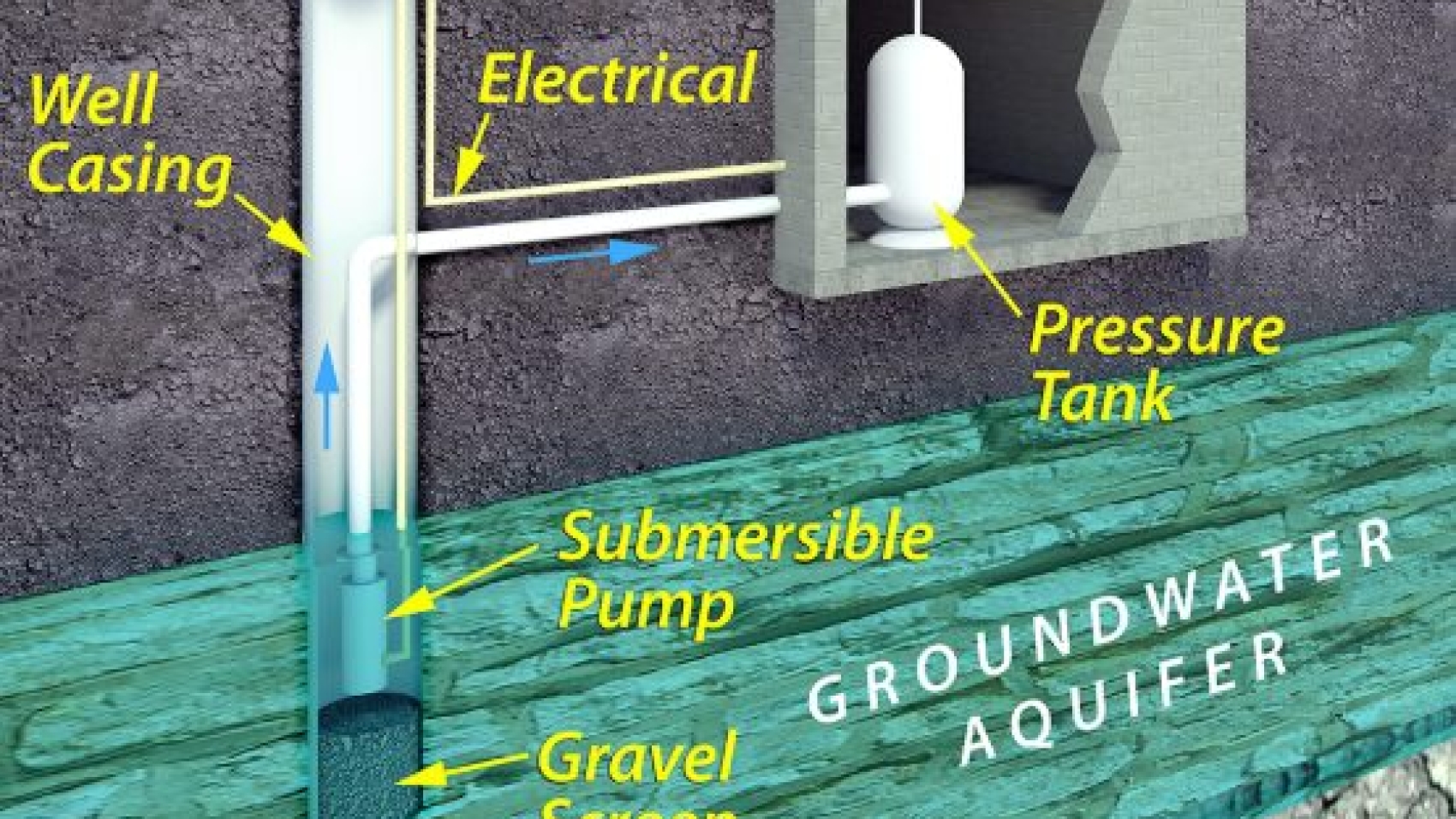
A private supply well system diagram

5 Common Well Pump Problems (And How to Fix Them Fast)

It’s easy to take water for granted until the moment you turn on the tap and nothing happens. For those on a private well system, your pump is the silent workhorse of your home. When it falters, it doesn’t just disrupt your chores—it halts your entire daily routine.

Understanding what’s happening deep underground can save you a lot of stress. Here is a guide to the five most common well pump problems and how to navigate them.

1. No Water at the Tap

Usually, this is an electrical communication breakdown. Before calling a pump professional, check the power supply to the pump.  Ideally this will be on a dedicate circuit – so have a look at your consumer unit. 

Often borehole pumps have a small ‘starter’ box.  These units have a thermal overload built into them, they have a small reset button on them that ‘pops’ out if the pump draws too much current.  Resetting this may solve your problem, but we’d advise you get it checked by an expert as it tripped for the a reason.  These boxes often also contain the capacitor for the pump, and this is a common point of failure.  If you system is controlled by a pressure switch its best to leave the investigation to the professionals.

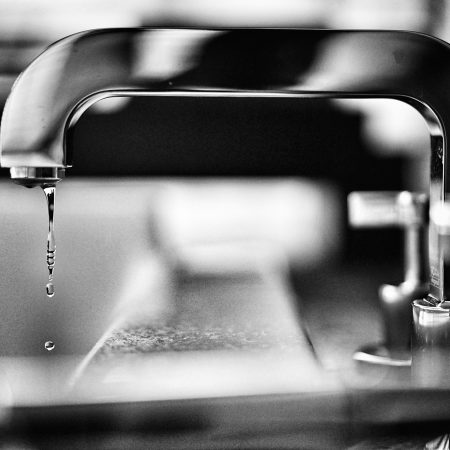
An image of a water tap

2. Sputtering Taps (Air in the Lines)

If your taps “spit” air when you first turn them on, your plumbing has been breached. This can happen if there is a crack in the drop pipe or if the water level in your well has dropped below the pump intake. This is a mechanical emergency; turn the pump off to prevent the motor from seizing.

3. The Pump "Short Cycling"

You’ll notice this issue when your stood near the pressure switch that controls your borehole pump.  Short cycling is when your pump clicks on and off rapidly while you’re using water. This is almost always caused by a failed pressure vessel. Without a proper cushion of air in the tank, the pump hits its “off” pressure almost instantly. This constant starting and stopping will eventually burn out your motor.

4. Low Water Pressure

If the flow seems to “pulse” or has simply become a trickle, your system is struggling. This is often a sign of a clogged sediment filter or a failing pressure tank bladder. It could also mean the pump’s internal components are worn down from years of use.  Your filters should be changed regularly.

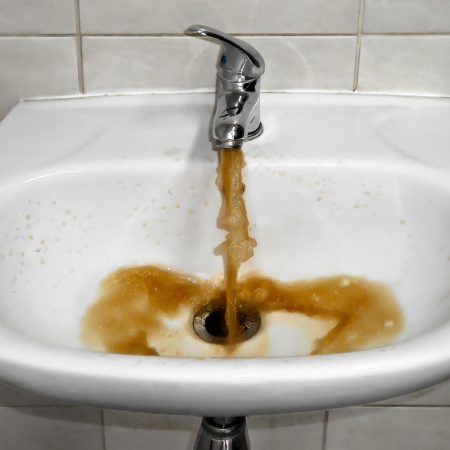
An image of a dirty water coming out of the tap

5. Sand or Silt in the Water

Finding grit at the bottom of your bathtub? This often means the pump is sitting too close to the bottom of the well and is sucking up silt. It can also indicate that the well screen has degraded, allowing debris into the system which acts like sandpaper on your pump’s internals.  It may also be time to change and review the type of sediment filtreation you have on the your system.  Borehole supplies should have a 5micro filter installed.

The Troubleshooting Flowchart: Should I Call a Pro?

Follow this logic to decide whether to grab your toolkit or your phone.

  • Is there NO water? Reset the circuit breaker once. If it trips again, or if your pressure gauge reads 0, you need a professional.
  • Is the water spitting? Turn the power off immediately. This requires an inspection of the drop pipe or well depth.
  • Is the pump clicking constantly? Check for system leaks. If you find none, the issue is internal to the pressure tank.
  • Is the pressure low? Check your sediment filter. If it’s clean but the pressure is still low, the pump itself is likely failing.
  • Is the water dirty? Check your filtration system first. If the grit continues, the pump placement needs adjusting.

DIY vs. Professional Action Table

This table summarizes the problems above and clarifies exactly when you can handle it yourself.

Problem

DIY Action

When to Call Mawdsleys

1. No Water

Reset circuit breaker (once).

If the breaker trips again or the pressure switch is burnt.

2. Sputtering Taps

Turn off the power to save the motor.

To repair drop pipes or address low water levels.

3. Short Cycling

Check the house for leaking taps/toilets.

To recharge or replace the pressure tank bladder.

4. Low Pressure

Clean or replace sediment filters.

If pressure remains low after filter changes.

5. Dirty Water

Inspect and flush your filtration unit.

To pull the pump and inspect the well screen.

How Mawdsleys Pump Services Can Help?

While DIY checks are a great first step, well systems involve high-pressure water and high-voltage electricity. At Mawdsleys, we bridge the gap between a problem and a permanent solution.

Our Competencies:

  • Rapid Diagnostics: We use precise testing to find the exact failure point, saving you from replacing parts that still have life in them.
  • 24/7 Emergency Support: Water emergencies don’t stick to a 9-to-5 schedule, and neither do we.
  • Clear, Precise Communication: We explain the technical “why” in plain English, ensuring you’re informed every step of the way.
  • Proven Reliability: Our Google Reviews highlight our commitment to getting the job done right the first time.

Our Value Statement: We deliver swift solutions for your pump equipment every day. Reliable, Rapid, Informative.

A photo of one of our vans in front of our HQ
Before & After

Investing in Our Workshop – For Better Service and Better Wellbeing

At Mawdsleys BER, continuous improvement isn’t just something we talk about — it’s something we actively invest in. Over recent months, we’ve made several key upgrades to our workshop to ensure we deliver an even more reliable service for our customers, while also creating a safer, more comfortable working environment for our engineers.

Increased Capability

One of the biggest improvements is the installation of a new 5-ton overhead crane, allowing us to handle large and heavy motors more efficiently and safely. This upgrade improves turnaround times, reduces manual handling risks, and ensures we can continue to support complex repair and rewind projects with confidence.

Crane installation

A Safer, More Comfortable Working Environment

To further support our engineers’ wellbeing, we’ve upgraded our workshop flooring to a hardwearing PVC system designed specifically for demanding industrial environments. The new flooring is capable of withstanding high point loading and impact, while offering excellent durability and slip resistance to improve safety across the workshop.

Beyond safety, the flooring delivers real day-to-day benefits. It reduces dust and noise, creating a cleaner and more comfortable working environment, and its ergonomic properties help reduce fatigue for engineers spending long hours on their feet. As an environmentally sustainable solution, it also aligns with our commitment to responsible investment and long-term efficiency.

Smarter Storage and More Efficient Workspaces

We’ve also replaced our workbenches and tool cabinets with high-quality, Italian-manufactured units, built with exceptional attention to detail and durability. These new systems combine tool storage and worktops in one, saving valuable workshop space and improving overall workflow compared to our previous separate setups.

Each cabinet features heavy-duty ball-bearing drawer slides for smooth operation, with drawer bases protected by foamed rubber mats to prevent tools from sliding or becoming damaged. A front-centralised locking system enhances security, while vertically adjustable feet ensure stability on the workshop floor, even under heavy loads.

We believe that investing in our employees is one of the most important investments we can make. Skilled, supported engineers deliver better quality work — and that’s exactly what our customers expect from Mawdsleys BER. These improvements are part of our ongoing commitment to getting better at what we do, every single day.

If you are interested in purchasing workbenches and tool boxes in great condition, follow the links below.

Link 1 
Link 2

An image of a photo of our asset management system

Asset Management Systems: A Pillar of Quality Service

In the world of pump maintenance, certainty is everything. Buildings depend on their pumps the way a city depends on its water supply—quietly, constantly, and critically. And behind that reliability is a tool most people never see: an asset management system.

At Mawdsleys Pump Services, ours is powered by EMiR, the industry-leading system that turns maintenance into a precise, data-driven science.

What Is an Asset Management System?

Think of an asset management system as a living archive for all rotating electrical assets (booster sets, pressurisation units, submersible pumps, air handling units, circulation pumps and motors). Instead of scattered paperwork and fading memory, EMiR captures the entire lifecycle of your equipment—installations, site photos, service reports, notes, components, and future schedules.

In short: It keeps every detail, of every asset, perfectly organised and instantly accessible.

This foundation is what makes everything else possible.

An image of a lady working on a laptop

1. A Unique Identity for Every Asset

Every system we install or service receives a unique asset number—a digital fingerprint that unlocks its entire history. With a quick scan, engineers can see:

  • Previous service reports
  • Photographs and notes
  • Location specifics
  • Past issues and recommendations

This saves time and avoids repeated or unnecessary work.

2. Built for Every Customer, Not Just Big Estates

Most systems like this are designed for sprawling commercial sites. Ours isn’t. This ensures all customers—from small property owners to estate managers responsible for multiple buildings—benefit from: consistent records, simpler servicing, and a clear picture of your full asset portfolio.

3. Compliance That Manages Itself

Once the service is completed, EMIR sends you the report and automatically schedules the next service to ensure:

  • No missed assets.
  • No forgotten inspections.
  • No compliance headaches.

And if you ever need a report—from last month, or last decade—we can retrieve and resend it in minutes.

4. Predictive, Cost-Saving Maintenance

By analysing the full history of each unit, EMiR helps us identify patterns and predict future issues. This lets us fix problems before they cause downtime.

The result: fewer emergencies, better system performance, and lower costs.

Final Thoughts

By partnering with Mawdsleys Pump services you receive the benefits of a robust asset management system which supports your safety, compliance and efficiency goals. It helps us deliver a streamlined, data-driven service that makes life easier for you—while protecting the performance and longevity of your equipment.

If you’d like to learn more about how our asset management system can support your facility or estate, get in touch with our team.

An image of a puddle with brown and yellow leaves

Stormwater Pump Maintenance: How to Prevent Winter Breakdowns

As the rainy seasons are already here, the demands and the risks on your stormwater pump system increase dramatically. Winter brings challenges such as heavy rainfall, twigs, leaves and fluctuating usage — all of which can strain your system. Without proper stormwater pump maintenance, these factors can lead to unexpected failures, costly repairs, and unpleasant disruptions.

At Mawdsleys Pump Services, we specialise in comprehensive stormwater pump maintenance and emergency support, helping our clients stay operational throughout the colder months.

Why Stormwater Pumps Need Maintenance Before Winter

Winter can be one of the harshest times of the year for your pumping system due to several environmental and mechanical factors:

  • Debris: During autumn and winter, the heavy rainfall can guide a lot of leaves, twigs and silt into your system, which can compromise it and is a serious danger.
  • Heavy Rain and Flooding: Increased water inflow forces pumps to work harder for longer, wearing out key components.
  • Reduced Use or Idle Periods: Infrequently used systems can suffer from hardened debris, seized impellers.
  • Electrical and Control Failures: Damp or cold weather can affect control panels, wiring, and sensors, leading to false alarms or total system failure.

An image of a puddle with brown and yellow leaves

Common Winter Pump Problems

Without regular submersible pump maintenance, systems can quickly develop avoidable faults. Below are the most frequent winter issues — and why they happen:

1. Pump Blockages – Twigs, leaves and silt in the impeller and flow channels, leading to inefficiency or pump failure. In winter, these materials harden faster, making blockages more severe.

2. Motor Burnout – Overworking during high inflow events or faulty float switches can cause the motor to overheat and fail. Preventive maintenance can identify early signs of overload.

3. Float Switch Failure – Faulty or dirty floats prevent proper start/stop cycles, causing the pump to either fail to activate or run continuously.

4. Pump Not Turning On -Electrical faults, stuck floats, or seized impellers can prevent activation. Routine inspections catch these before they cause flooding.

5. Pump Not Turning Off – Constant running increases energy consumption and accelerates wear on internal components. This issue is often linked to float switch or relay faults.

6. Frequent High-Level Alarm Activation – A high-level alarm means the pump isn’t keeping up with incoming flow — often due to blockages or component failure. Ignoring it risks flooding and equipment damage.

7. Control Panel Faults – Cold, damp conditions can cause water ingress in control panels, leading to component failure. Regular maintenance keeps panels clean and protected.

8. Non-Return Valve Blockage – If blockage of the NRV happens, the pumps will function much more than usual, and there is an increased risk of flooding and increased energy costs.

An image of a flooded street

How to Prevent Stormwater Pump Breakdowns

Preventative action is always cheaper than emergency repair. Here’s how to prepare your system for winter:

  1. Book a Pre-Winter Inspection: Our engineers will inspect, test, and service your pump, test the control panel and controls to ensure they are in top condition.
  2. Check the Control Panel: If you see any indicators of problems with the system, get in touch with a specialist as the earlier any issues are sorted, the better. 
  3. Check for Standing Water Around Drains: If the sump is overflowing or drains are backing up- this is an indication of a blocked or malfunctioning system.
  4. Schedule Regular Storm Pump Maintenance: Set up an ongoing maintenance plan with Mawdsleys to keep your system reliable all year.

Benefits of Routine Stormwater Pump Maintenance

A structured stormwater pump maintenance plan offers long-term protection and savings:

  • Fewer Breakdowns: Catching faults early reduces emergency callouts and expensive repairs.
  • Energy Costs: Clean, regularly maintained pumps and controls consume less power and operate more effectively and do not use excess energy.
  • Extended Lifespan: Well-maintained pumps last longer, delaying costly replacements.
  • Priority Support: Maintenance customers receive faster response times and emergency service priority.
  • Regulatory Compliance: Stay compliant with environmental standards and receive detailed maintenance reports.
  • Peace of Mind: Regular checks ensure your pump system performs when you need it most — especially in winter.
An image of an engineer fixing a control panel

Prepare for Winter with Mawdsleys Pump Services

Don’t let flooding take your system by surprise. With professional submersible pump maintenance from Mawdsleys Pump Services, you can prevent problems before they start and keep your pumps performing efficiently all year long.

Achilles UVDB Silver Stamp

Mawdsleys achieves Achilles UVDB Accreditation with 99% Score

We are pleased to announce that Mawdsleys has successfully achieved Achilles UVDB accreditation, a significant achievement that underscores our commitment to maintaining the highest standards in health, safety, and quality management systems.

What is Achilles UVDB?

Achilles is a global leader in supply chain risk management, particularly within the Utility Sector. Their certification process is rigorous, designed to ensure that companies like ours not only meet but exceed industry standards. By earning this accreditation, we’ve demonstrated that Mawdsleys BER is serious about the systems and processes that keep our operations safe, efficient, and reliable.

Why is this Accreditation important?

The Achilles UVDB certification is particularly important to us because it reinforces our role as a trusted partner for our Utilities customers, both long-standing and new. Achieving this certification with an impressive overall score of 99% is a testament to the hard work and dedication of our team. It reflects our ongoing commitment to excellence and our determination to uphold the highest standards in everything we do.

This milestone is a proud moment for all of us at Mawdsleys BER. It not only validates the strength of our systems and processes but also reinforces our commitment to continuous improvement. We are excited to continue delivering exceptional service and quality to our customers, now with the added assurance of Achilles certification.

Talk to the Experts

For more information about our services and our commitment to quality and safety, or to learn more about how our Achilles Certification benefits your business, please don’t hesitate to get in touch.

Give us a call today on 0117 955 2481 or fill out a contact form and we will get back to you.

An image of two of our engineers lifting a sump pump of a sewer

8 Common Problems with Sewage Pumps and How to Fix Them

Sewage pumps are critical to wastewater management in almost every type of premises — from private homes to large commercial and industrial sites. When they develop a fault, the consequences range from inconvenient to seriously disruptive: backed-up toilets, overflow risk and costly downtime.

This guide covers the 8 most common sewage pump problems, what typically causes them, and what you should do — including when the situation calls for professional sewage pump repair, a maintenance visit or a review of your current servicing arrangement.

If you need urgent help, call our team now on 0117 954 8030. We operate 24/7, 365 days a year.

A sewage pump being taken out of a manhole

1. The Sewage Pump Won’t Start

A sewage pump that fails to start is one of the most common call-outs we attend. Causes include:

  • Power supply failure or tripped circuit breaker
  • Faulty control panel or sensor
  • Motor failure
  • Debris or a blockage jamming the impeller
  • Pump seized after a prolonged period without use

What to do: Check the power supply and control panel first. If there’s no obvious electrical fault, do not attempt to free a jammed impeller manually — contact a pump engineer. An experienced technician will carry out a full diagnostic inspection and carry out the sewage pump repair on-site where possible, or arrange a swap-out to minimise downtime.

2. The Sewage Pump Won’t Turn Off

A pump running continuously is often caused by a stuck or failed float switch, or a blockage preventing the water level from dropping. A tell-tale sign is an unexplained spike in electricity bills.

Running a sewage pump dry — without water to cool the motor — will damage the seals and ultimately destroy the pump entirely.

What to do: If the pump is non-critical, isolate it by cutting the power. Then arrange an inspection with an engineer as soon as possible. Float switch replacement is a straightforward sewage pump repair, but left unattended, the fault will cause far more expensive damage.

An image of a toilet roll with "Don't panic" written on it

3. Toilets Are Backing Up

Toilet backups linked to a sewage pump are usually caused by a blockage within the pump, a fault at the sewage treatment plant, or a septic tank that needs emptying.

What to do: Stop using toilets, taps and drains immediately — every flush adds more wastewater to an already overloaded system. Contact a pump engineer urgently. This is not a fault that resolves itself, and continued use will escalate the problem quickly.

4. Leaking from the Pump or Pipework

Leaks are typically caused by cracked pipework, a failed non-return valve, or a perished seal. A failed non-return valve allows sewage to recirculate back into the sump — the pump then has to work harder to keep up, increasing both energy consumption and wear.

What to do: Carry out a visual inspection to locate the source of the leak. If you can identify the failing component, you may be able to order a replacement part and describe the fault clearly when you call. If you cannot identify the leak, contact a pump engineer immediately.

⚠️ Leaks from a sewage pump are a serious emergency. Raw sewage leakage poses a health risk and can cause significant structural damage. Call us now on 0117 954 8030 for fast 24/7 support.

Regular sewage pump maintenance will catch seal and valve deterioration before it becomes a leak — this is one of the most common faults our engineers identify during scheduled service visits.

5. The High-Level Alarm Is Sounding

High-level alarms are designed to trigger when water in the pump chamber rises to a critical level — usually because the pump has failed or is running below capacity.

What to do: Do not silence the alarm and carry on. Switch off the pump, stop using water on the premises, and contact an engineer for emergency assistance. Ignoring a high-level alarm risks sewage overflow.

6. Loud Noises from the Pump (Vibrations, Banging)

Unusual sounds are often caused by loose or improperly secured pipes vibrating under pressure, a malfunctioning check valve causing water hammer, or an impeller that has come loose within the pump casing.

What to do: Carry out a visual check of the pipework fixings and pump housing. If the noise is coming from inside the pump body, do not attempt to access it — arrange an inspection with an engineer who can assess the impeller and valve and carry out the appropriate sewage pump repair.

An image of two of our engineers lifting a sewage pump

7. Pump Burnout

Burnout is one of the most costly outcomes of a neglected sewage pump system. Common causes include:

  • Using the wrong pump for the application (wrong flow rate or head pressure)
  • Heavy usage surges exceeding the pump’s capacity
  • A failed float switch causing the pump to run dry
  • Incorrect overload settings on the control panel
  • A partial blockage making the motor draw excessive current

What to do: If you have experienced burnout, the pump will need to be replaced or fully overhauled. More importantly, the root cause needs to be identified — otherwise the replacement pump will suffer the same fate. Speak to one of our engineers about a pump suitability review. Correct sizing, correct installation, and a planned sewage pump servicing schedule are the most effective ways to prevent burnout from recurring.

8. Bad Smells Coming from the Pump

Persistent foul odours usually point to one of three causes: a failed or perished seal on the chamber lid, a cracked vent pipe allowing gases to escape, or stagnant water in a low-usage system where sewage is sitting rather than being regularly moved.

What to do: Have an engineer inspect the pump, chamber lid and vent pipework. In the case of stagnant water, the issue may be resolved by adjusting run times or reviewing the pump sizing. Regular sewage pump maintenance — including checks of seals and vent pipes — will catch this type of deterioration early.

How Planned Sewage Pump Servicing Prevents Most of These Faults

The majority of the faults above share something in common: they don’t appear without warning. Float switches degrade gradually. Seals perish over time. Valves wear. Blockages build up. In almost every case, a planned sewage pump servicing visit would have caught the early signs before they developed into a breakdown.

At Mawdsleys, our sewage pump maintenance visits include:

  • Visual inspection of the pump, chamber and all pipework
  • Float switch and level control testing
  • Non-return valve condition check
  • Motor insulation and current draw testing
  • Wet well cleaning and de-ragging
  • Written condition report with any recommendations

For clients on a servicing contract, we also provide priority response times and discounted call-out rates when emergencies do occur.

If your sewage pump has never been serviced, or your last service visit was more than 12 months ago, it’s worth getting in touch. A single maintenance visit costs a fraction of an emergency repair — and far less than a pump replacement.

Find Out About Our Servicing Contracts →