
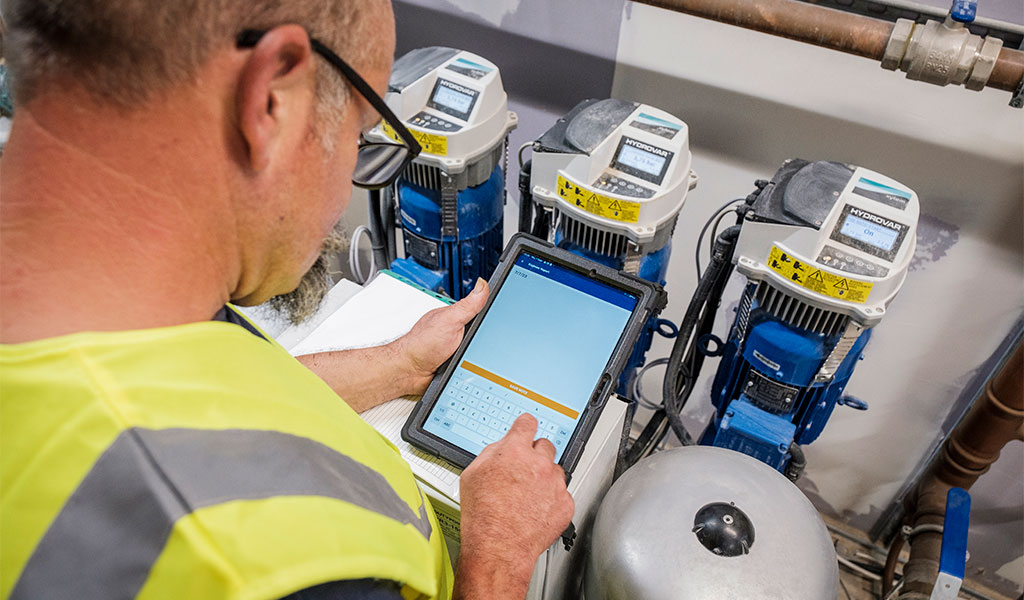
Booster pumps play a vital role in environments such as schools, blocks of flats and apartments, public buildings and offices, increasing water pressure to enable the transportation of water across several storeys.
When booster pumps fail, the result can be extremely disruptive for building users, with water pressure dropping and, in some cases, water supplies being cut off completely.
Unfortunately, many premises that rely on a booster pump go without regular qualified maintenance, leaving essential checks to on-site teams who may not have the skills, tools, or expertise to properly maintain pumps or notice when something is wrong before it’s too late.
Read on to find out how often a booster pump needs maintenance, what’s included in a professional booster pump service, signs that a service may be due, and a checklist to help you carry out routine checks yourself.
Recommended Booster Pump Service Frequency
If you’re responsible for the care and ongoing maintenance of a booster pump, you should aim to have it serviced by a professional pump engineer annually. Preventative maintenance of your pumps through a regular pump service plan offers a number of benefits including:
- Reduced risk of unexpected breakdown.
- Increased efficiency of the pump.
- Decreased risk of injury from pump malfunction.
- Higher building user satisfaction.
- Reduced noise and vibration from the pump.
- Rectification of small problems before they develop into larger (and more expensive) ones.
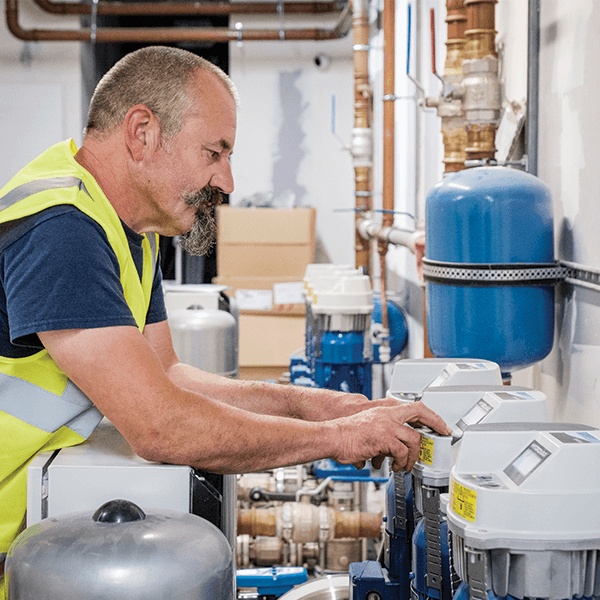
What’s Checked During a Booster Pump Service?
During a booster pump service with Mawdsleys Pump Services, a number of key components are inspected to assess their condition. Before the inspection begins, a full risk assessment and method statement is completed. The service itself covers four main areas:
Pump identification and condition
- Pump information recorded, including serial number, kW, voltage, amps, and phase
- Check for rust or other degradation on key components
- Rotation of motors checked
- Hours run recorded
Pressure and water system
- Water tank ball valve checked
- Inlet pipework and valves inspected
- Outlet pipework and non-return valves/valves inspected
- Pressure vessels checked
- Tank pressure checked
- Gauge and pressure sensor checked
- Start and stop pressure tested
- Speed control system checked
Electrical system
- Single phase and three phase checked
- Running amps measured
- Earth and bonding checked
- Earth trip tested
- Control panel and panel indicator bulbs checked
Final checks
- Pumps tested
- System returned to automatic mode
Throughout the inspection, vital components such as bearings are replaced where needed. Following the visit, a full written report is issued highlighting any areas that require remedial work or may soon require attention.
Signs That Your Booster Pump Is In Need Of a Service
In addition to your regular maintenance contract, you should call in a professional pump engineer if you notice any of the following:
- Excessive vibration from the pump.
- Excessive noise being created by the pump. Read our blog to find out more about controlling noise in your booster pump system.
- Low water pressure.
- No water pressure.
- Rust or degradation within any component of the pump.
- Leaking from pipework or pump unit.
- Increase in energy bills.
Booster Pump Maintenance Checklist: What to Check Yourself
Alongside your annual professional booster pump service, regular checks between visits help catch developing problems early. Before carrying out any pump maintenance or visual checks yourself, consult the pump manufacturer’s supply manual and make sure you have the right protective equipment. We recommend the following checks on a monthly basis:
- Visual inspection of the shaft seal for any leakage — call a professional pump engineer if you notice any leakage
- Visual inspection of the pump’s pressure and discharge gauges — any abnormal readings should be assessed by a professional pump engineer
- Check the pump’s foundation to ensure the frame is secure — tighten any loose bolts, but if this keeps recurring it could be a sign of excessive vibration
- Check vital components of the pump for any rust or other degradation
To help you keep on top of routine maintenance between professional services, we’ve created a free inspection checklist for responsible persons. Download your copy here.
Booster Pump Maintenance Contracts at Mawdsleys
At Mawdsleys Pump Services, we offer pump maintenance and servicing contracts for all types of pumps within any environment.
Our maintenance contract users benefit from priority response, regular preventative maintenance visits, 24/7 call out and more to ensure their pumps are running as efficiently as possible with minimal risk of breakdown.
For more information about our pump maintenance contracts or any of our other services, give one of our expert team a call today on 0117 954 8030.
Booster Pump Maintenance and Service FAQs
Costs depend on the size and complexity of your system, the number of pumps in the set, and whether you’re booking a one-off service or an ongoing maintenance contract. A maintenance contract is usually the most cost-effective option for buildings that depend on consistent water pressure, as it includes scheduled visits, priority response, and 24/7 call-out as standard. Call us on 0117 954 8030 for a tailored quote.
In-house monthly checks are visual — looking for leaks, abnormal gauge readings, loose fittings, or rust. A professional booster pump service goes much further, covering the pump’s electrical system, pressure system, and mechanical condition in detail, replacing worn components such as bearings, and issuing a written report. The two work together: monthly checks catch obvious issues early, while the annual service catches what an in-house team can’t.
Skipping a scheduled service increases the risk of unexpected breakdown, reduces the pump’s efficiency, and means small, inexpensive issues are more likely to develop into larger, more costly failures. It can also affect water pressure and reliability for building users in the meantime.
Both are available. A maintenance contract is generally recommended for buildings that rely on consistent water pressure, since it includes priority response and 24/7 call-out alongside scheduled visits. One-off services suit smaller systems or properties with lower demand. Speak to our team about which option suits your building.