Irrigation systems for sports fields

Keep Your Cricket Pitch In It’s Best Shape With A Portable Irrigation System

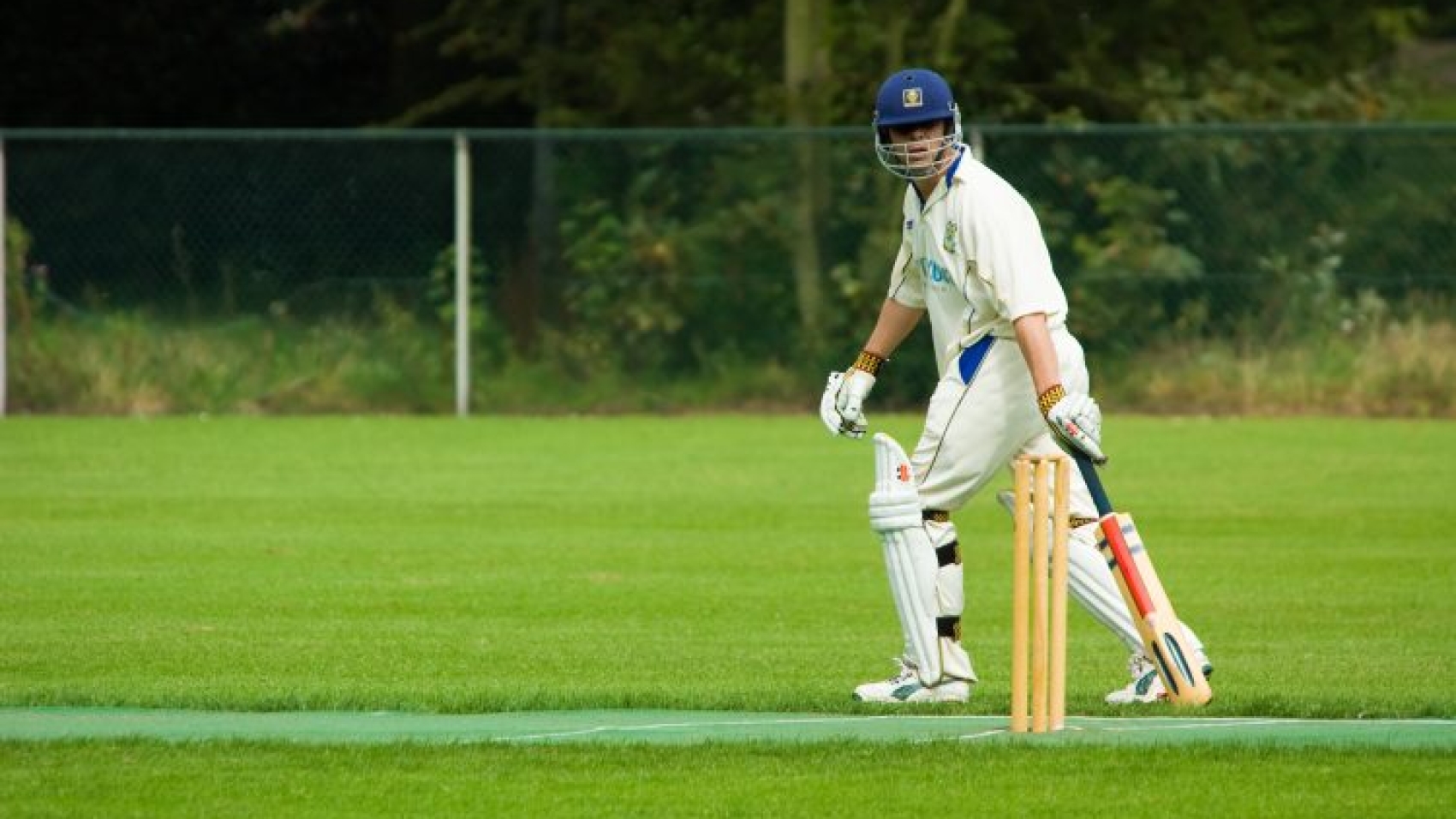
Cricket season has begun, teams across the nation will be playing regularly from early March to late September and as any player, groundskeeper or spectator of the sport will know that the quality of the pitch is one of the most important parts of the game.

There are also a number of risks that can arise from poor irrigation on sports fields, including injuries and games being called off.

Find out more about why a good quality pitch is so important for the sport – and the options available to ensure yours is exceptional.


The England & Wales Cricket Board – Recommended Pitch Quality

Having a high-quality pitch allows players to perform at their best, bobbles and dry patches or cracks on the pitch mean wayward bowls, frustrated players and potential injuries, cricket games usually go on for up to five hours – so it’s essential they can maintain their quality for this long.

A couple of the guidelines the ECB set out to ensure the best quality include:

  • The cricket square requires a firm and even surface.
  • The outfield should provide a ‘fast and true’ surface that provides a good and safe foot for the fielding team to prevent injuries and improve the standard of play.
  • Even at the lowest tier of the game, the ball should bounce properly throughout the game.
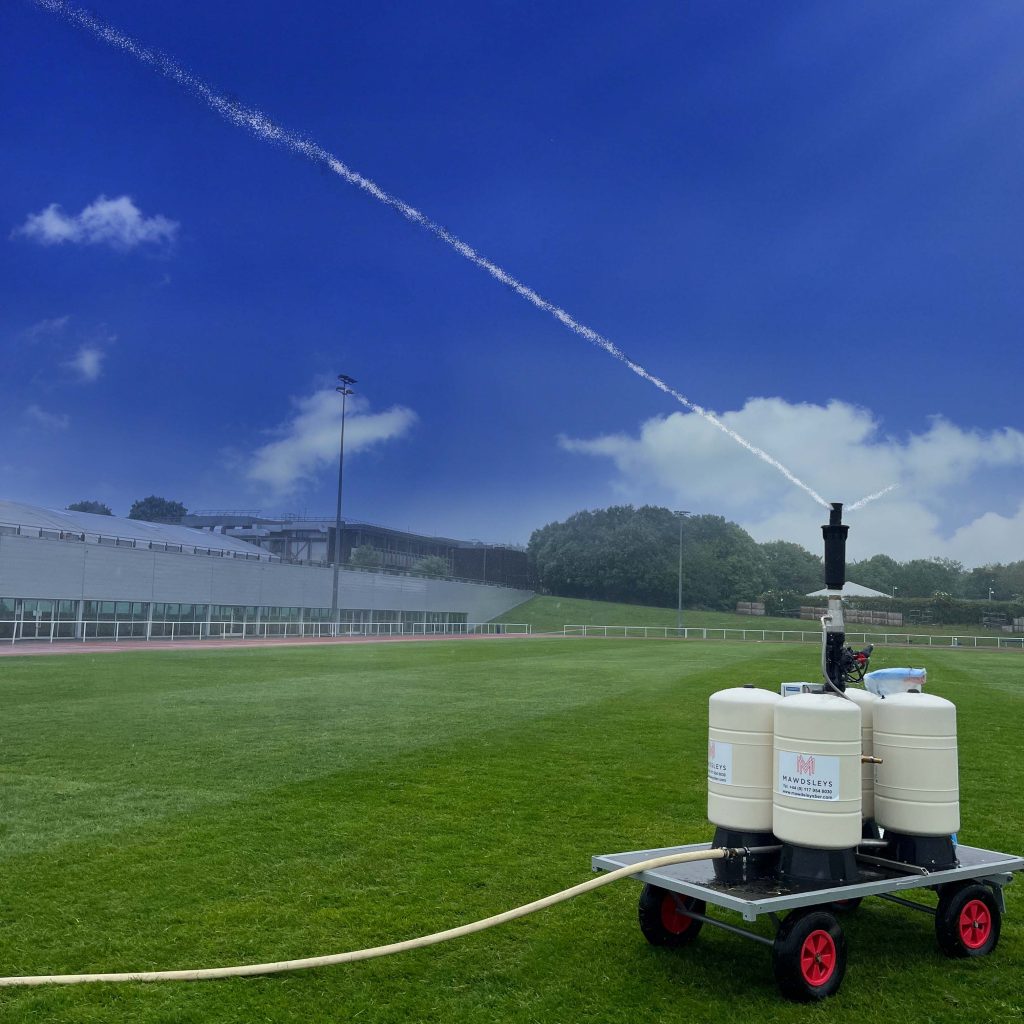
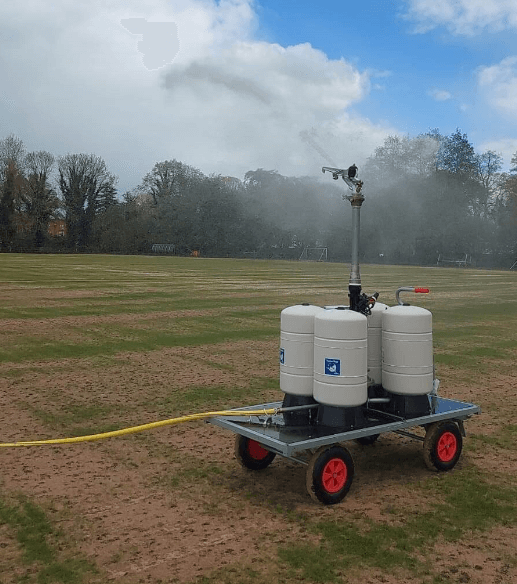
An image of our Long Range Irrigator on a rugby field

How Can A Long Reach Irrigation System Benefit Me As A:

Groundsman:

  • An LRI system allows you to effortlessly maintain your pitch without the time needed for manual watering or budget needed for a pop-up sprinkler system.
  • The versatility of an LRI system means you can water the pitch only when needed, this eliminates the chance of the pitch becoming waterlogged or dried out.
  • Our most popular LRI systems (25 & 50) have a radius of 25m & 50m and are able to run on water supplies with low pressure – meaning you won’t need to invest in upgrading your water system.
  • Keeping on top of your pitches health removes the need for any expensive re-seeding in the future.

Player:

  • A high-quality pitch allows you to play at your best – bowls will run across the wicket smoothly without any bobbles – this also makes for a fairer game.
  • When the pitch is in good condition, fielders will fall less often – reducing the risk of injury.
  • If it is a particularly hot day, the LRI system can be used during the break to ensure it remains at a good standard throughout the day.

Can We Afford To Have A Great Quality Pitch As A Lower-Tier Club?

Despite what you may think, you don’t have to be a high-tier club to have a great pitch. Our LRI systems are ideal for clubs who can’t afford to invest in underground systems or pop up systems – allowing you to quickly water your pitch and even adjust their position to target problem areas where the pitch is frequently drying up.

Get your free quotation today! Call us on 0117 954 8030

What Other Sports Pitches Use Irrigation?

Aside from cricket fields, our LRI systems have proved to be very effective across a number of different sporting fields including:

Football Pitches – In the highest leagues of football, clubs usually have pop-up sprinkler systems and huge grounds teams. Portable irrigation is the perfect solution for having a great quality pitch without the hefty price tag – we have supplied LRI systems to a number of mid to high-tier clubs throughout the years including, Taunton Town FC, Hoddesdon Town FC and Bristol Rovers FC.

Rugby Pitches – Because of the nature of the sport, good irrigation for rugby pitches is absolutely essential, not only is there a lot of wear tear on the pitch – but players tend to get injured more frequently and landing on hard ground can make injuries more severe. We have provided irrigation for all tiers of rugby clubs, from local teams right the way through to Rugby World Cup training grounds.

In addition to these, LRI systems are also used for hockey fields, school sports fields and equestrian centres. They can also be used in industrial application such as dust suppression in quarries.

Portable Irrigation System Video

 

2 engineers in hi vis jackets in front of two Mawdsleys Vans

Don’t let your pitch get a red card for poor irrigation

With football season almost over and summer just around the corner, now is the perfect time to rethink the upkeep of your playing field. Low quality dry or hard pitches are a constant source of embarrassment for clubs and also one of the most common causes of injury in rugby and football; an irrigation system can provide you with a professional standard of pitch at a fraction of the cost.

2 engineers in hi vis jackets in front of two Mawdsleys Vans

Give your Turf a Sporting Chance with the Right Irrigation

We expect a lot from our sports fields.  We increasingly want them to stand up to longer playing seasons, a multitude of uses and all the punishment that the British weather can throw at them.  Waterlogged one minute, dry and parched the next, then completely frozen solid – it’s a wonder that the poor turf doesn’t just decide to give up all together.

Rise to the challenge

If you’re a Groundsperson, you probably feel like you’re fighting your own battle against Mother Nature. No doubt you’re working with constricted budgets and the pressure of having to provide a cost effective service – all while trying to ensure your sports ground looks beautiful and provides a safe surface to play on.

No matter what your sports field is used for, compaction is likely to be your biggest challenge.  Not only is it the primary factor in sporting injuries, it can also mean death to turf. In a compacted soil, the roots have little chance to absorb the air and water they need to feed the grass and ensure its survival.  

Start with good irrigation

The right irrigation system can make your life so much easier. Whilst many sports grounds already use sprinkler systems, better results could be achieved by using a portable long reach irrigation system. These systems can be moved around the pitch, delivering water exactly where and when it’s needed. This ability to control the amount of water delivered in any one place means you can avoid overwatering an area which is prone to waterlogging or concentrate on areas which are especially dry or compacted.

Mark Perrin, Head Groundsman at Crystal Palace Football Club has a system supplied by Somerset Pumps and told us, “We use our long reach irrigators all the time. It is particularly good before training sessions or matches when we need to lightly water the whole pitch in a very short time – the LRIs only take one hour to water the whole pitch, whereas ordinary travelling sprinklers take 3 hours.”

The benefits of a portable long reach irrigation system

These systems can be a real boost for clubs who can’t afford to invest in an underground watering system. Our portable long reach irrigator is the only system of its kind which can run off a standard mains supply.  It’s also able to water large areas of turf quickly and efficiently, even if you’re in an area with poor water pressure. What’s more, it’s easy to move so can be used across all your pitches and to target specific problem areas.

Someone else who wouldn’t be without their Somerset Pumps portable long reach irrigation system is FA Groundsman of the Year, Kevin Turney. He says, “It’s an invaluable part of the grounds team and has never let us down. It has to be seen as an investment not a cost as without it our pitch would be nowhere as good as it is today.”

How our systems work

Here at Mawdsleys Pumps, we have different sized systems available, depending on the size of your sports ground. Both units can be left to run unattended day and night without problems and are free standing and completely portable. In fact they work just like a permanent underground system but for a fraction of the cost.

If you do not have access to a water source with adequate pressure, we can assist with the design and installation of a tank and pump to suit your requirements.

All our football field sprinkler systems are supplied at a highly competitive price and offer significant savings over other pitch irrigation systems. To find out more and get up-to-date prices please get in touch or fill out the form below to request a callback

Perfect pitches for cricket, rugby and football

Different sports demand different playing surfaces but irrigation plays an important role in all of them. On cricket pitches it will help the soil particles stick together and aid the rolling process, while on rugby and football pitches, efficient irrigation will ensure the production of a healthy and resilient turf that delivers maximum playability and reduces the risk of match cancellations due to water logging or dry, hard surfaces.

Talk to the specialists

We’d love to help you produce the perfect playing surface. To find out more about any of our irrigation systems or talk to us about designing a bespoke solution for your sports ground, just call our friendly and knowledgeable team on 0117 954 8030.


2 engineers in hi vis jackets in front of two Mawdsleys Vans

Dirty Water Pumping Systems – Maintenance and Common Issues

Wastewater pumps — sometimes called dirty water pumps — are used wherever gravity alone can’t move water where it needs to go: pumping sewage into a main sewer, draining a commercial yard, transporting waste at a treatment plant, or managing dirty water and yard run-off on farms. The right pump for the job depends on the flow rate, pressure and distance the water needs to travel.

There’s never a convenient time for a wastewater pump to fail, but certain conditions make failure more likely. Heavy rainfall and falling leaves — most common in autumn — significantly increase the risk of blockages, while general wear over time affects seals, floats and electrical components year-round. Regular wastewater pump maintenance is the most effective way to prevent both.

This guide covers the most common problems we see in wastewater and sewage pumping systems, what causes them, and how a planned maintenance schedule prevents them from becoming costly breakdowns or emergency sewage pump repairs.

Common Problems with Wastewater Pumping Systems

Dirty Water Pump On Farm

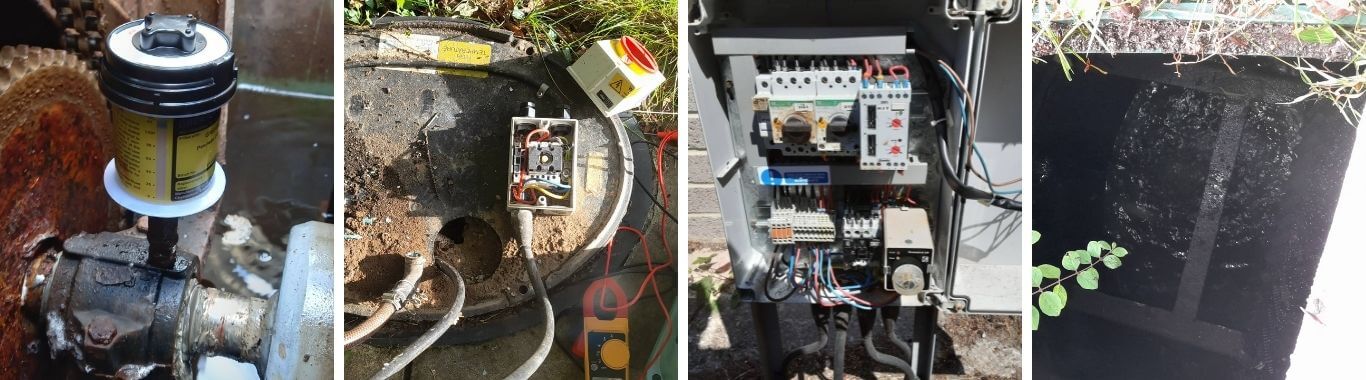
Pump Tripping the MCB (Miniature Circuit Breaker) This is often a sign that water has entered the pump’s motor winding. Heavy rainfall — more common in autumn than summer — increases the likelihood of this fault occurring. It can usually be resolved with a pump rewind; our dedicated rewind workshop in Bristol means we can have your pump back up and running quickly.

Phase Convertor Failure Over time, the phase convertor in a pump can fail, identifiable by underperformance or complete pump failure. We can overhaul your phase convertor at a fraction of the cost of full pump replacement.

Blockage by Rag This is one of the most common causes of failure in submersible wastewater and sewage pumps. In some cases it leads to complete stoppage, resulting in costly downtime and potential pump damage.

Floats Sticking Caused by grease build-up around the float switches. This can be reduced by fitting a grease trap, which separates fats and grease from wastewater before it reaches the pump.

Sump Pump Maintenance

Sump pumps are a specific type of wastewater/dirty water pump used to remove groundwater, flood water or surface water from basements, cellars and below-ground spaces. Many of the same faults covered above — float sticking, rag and debris blockages, electrical tripping — apply equally to sump pumps, but the consequences of failure are usually faster and more visible: a failed sump pump can let water levels in a basement rise within hours.

Regular sump pump maintenance should include float switch testing, a check of the non-return valve, a visual inspection for debris in the sump itself, and a test run to confirm the pump cuts in and out at the correct levels.

If you’re looking for sump pump maintenance near you, Mawdsleys covers Bristol, Bath, Cardiff, Gloucester, Exeter, Swindon, Southampton and the wider South West and South Wales region — call 0117 954 8030 to arrange a visit or discuss a maintenance contract. Find out more about basement and sump pumps →

Regular Pump Maintenance Plan

All of the issues above can be avoided with a maintenance plan, where every element of your wastewater pumping system is checked, maintained and any worn parts replaced before the pump actually fails. It’s always more cost-effective to prevent a pump failure than to wait for it to happen — not only do you avoid downtime, but you reduce the risk of consequential damage to the wider system, which is typically far more expensive than replacing a single worn part.

Early signs of potential pump or motor failure can be identified during routine maintenance visits. Mechanical seals and O-rings are checked as standard, and early detection prevents the kind of seal failure that leads to leaks, contamination risk and unplanned downtime.

A typical wastewater pump maintenance visit includes:

  • Visual inspection of the pump, motor and chamber
  • Float switch and level control testing
  • Non-return valve check
  • Motor insulation and current draw testing
  • Mechanical seal and O-ring inspection
  • Wet well or chamber cleaning where required
  • Written condition report

What to Do If Your Wastewater Pump Has Already Failed

Sewage Pump Repair — What to Do If Prevention Comes Too Late

If your wastewater or sewage pump has already failed — tripping the electrics, backing up toilets, or showing signs of reduced output — maintenance advice won’t help you in the moment. At that point, you need a sewage pump repair, not a service plan.

Mawdsleys provides emergency sewage pump repair across Bristol and the South West, available 24/7, 365 days a year. Many faults — including the ones covered above — can be repaired on-site during a single visit. Where a pump needs full strip-down or motor rewinding, it’s taken to our Bristol workshop and returned ready for reinstallation.

Call 0117 954 8030 for immediate advice or to arrange a repair visit. Find out more about our sewage pump repair service →


Agricultural Dirty Water Pumping Systems for Farmers

Mawdsleys has worked with farmers across the South West for many years, and we understand the agricultural industry’s specific water disposal needs. Whether you’re managing yard run-off, slurry disposal or dirty water from livestock housing, we offer practical, cost-effective pumping solutions based on a site visit, a full survey, and a no-obligation quote.

Our dirty water pumping systems for agricultural use come with a 2-year guarantee and our standard 24-hour breakdown call-out service.

Our Dirty Water Disposal System

  • Our standard system uses a submersible macerator pump, incorporating a non-return valve and anti-siphon device – eliminating air-locking and pump cycling.

  • A control system is provided and is monitored by a green bulkhead light which provides a visual indication that the system is ready for use.
  • The pump delivers out to manually movable sprinklers, generally 2 or 4 dependant on your needs, with each discharge 36 LPM (500 GPH) at a radius of 15 metres (49 feet).
  • The pump is generally installed on a fabricated steel base, supporting the pump in a position approximately 30 cm above the bottom of the pit providing a means of safely lifting the pump.
  • Our pumps are constructed with standard components so that replacement items are readily available for immediate dispatch if required.

Talk To Our Expert Team Today

If you need advice on wastewater pump maintenance, a sewage pump repair, or sump pump maintenance near you, our team covers Bristol, Bath, Cardiff, Gloucester, Exeter, Swindon, Southampton, Dorset, Cornwall and the wider South West and South Wales region.

Whether you need a free, no-obligation quote, a one-off repair, or want to discuss an ongoing maintenance contract, call us on 0117 954 8030.

Am image of a quarrying facility

Dust Suppression Methods For Quarries and Mining Sites

Controlling dust on quarries and mining sites is becoming an increasingly important consideration for operators. As well as having various health and safety legislations to adhere to for the safety of their workers and nearby residents. Excessive airborne dust can damage machinery on site, leading to expensive repairs and in turn loss of revenue through having to cease work.

Dust is created from various processes on quarry and mining sites whilst the materials are being sourced, crushed, screened, transported and stored – so it’s important to have a solution that can be implemented easily at any stage of material processing.

If you’re struggling with excessive dust on your quarry or mining site – read the post below.

An image of our long reach irrigator

The Effects of Poor Irrigation on Sports Fields

With summer just around the corner, there isn’t a better time to consider the health of your pitch in time for next season or to use for training. Dry, hard and withered pitches, playing fields and courses can cause serious problems for the players, groundskeepers and managers of the club – and be a constant source of embarrassment.

Take a look at the effects poor irrigation can have on your sports field, and why you should be taking the health of your pitch seriously before summer arrives.

Irrigation for Football Pitches

The football season is close to an end, and pitches have taken a good beating across this wet season. Pitches are now likely to be used for training in preparation for next season, so it’s important they stay healthy throughout the training season and are in their best condition for summer.

Poor irrigation can have the following impacts on pitches, the football team and the groundsman:

  • Grass takes longer to recover following a game – this can lead to dry and cracked pitches, or cause them to waterlog easily if it rains.
  • A poor playing service means the ball will bobble along the floor, making for a poor game.
  • If the pitch is poor quality, the referee can choose to call off the game causing teams to forfeit.
  • Tough pitches that aren’t irrigated properly have a low level of impact absorbency, meaning players are more likely to get injured if they fall over or are tackled.
  • If a pitch remains in bad condition and is not treated, re-seeding the pitch is an expensive and very time consuming process.

Irrigation for Rugby Pitches

Being a contact sport, it’s crucial for groundsman to ensure that the pitch is in its best condition to ensure the best playing surface. Poor irrigation of a rugby pitch has similar impacts to that of a football pitch; however, due to the nature of the sport, injuries to players being tackled onto a poorly irrigated pitch can be a lot more serious.

The Irrigation Solution: In an ideal world, a permanent underground pumping system would be the perfect irrigation solution; however, these systems are extremely expensive and often only used by professional clubs. A portable LRI system can do the job up to the same standard – for just a fraction of the cost. You can read our Taunton Town FC LRI success story to find out more.

Irrigation for Golf Courses and Bowling Greens

Bowls and golf are both summer time sports; therefore it is important that the green is in perfect condition in time for when the games begin. Irrigation can ensure an even spread of healthy grass and good quality surface for players that allows the balls to skim rather than stop.

The Irrigation Solution: Some golf courses do have pop up sprinklers installed, however, these are very expensive to install and maintain. A portable irrigation system allows groundsmen to choose the concentration of water to allow grass to grow evenly without water logging the green.

Choose the Right Irrigation with Mawdsleys Pumps

Whatever kind of sports pitch or playing field you are responsible for, we’d love to help you keep it in its best condition. To find out more about any of our irrigation systems, or to discuss creating a bespoke system to your requirements, give one of our expert team a call on 0117 954 8030.

An image of a sewage pump

Winter Sewage Pump Maintenance – Avoid Unexpected Breakdown This Winter

A sewage pump failure is never convenient — but it’s almost always preventable. Whether you manage a commercial premises, a residential property or a pumping station, planned sewage pump maintenance is the most reliable way to avoid unexpected breakdowns, protect your equipment and control costs.

This guide explains what good sewage pump maintenance involves, the most common faults that a service visit will catch early, and what to do if your pump develops a problem that needs repair. We also cover why winter is the most critical time to have your system checked — and why Mawdsleys is one of the few pump specialists that keeps operating through the Christmas and New Year period.

Need help now? Call 0117 954 8030 — we operate 24/7, 365 days a year.

What Does Sewage Pump Maintenance Visit Include?

A thorough sewage pump maintenance visit goes well beyond a visual once-over. Our engineers carry out a structured inspection that covers every component likely to cause a failure, including:

  • Float switch and level controls — the most common cause of pump faults. Tested for correct operation and adjusted or replaced as needed.
  • Non-return valve condition — a failed valve causes sewage to recirculate within the sump, increasing motor load and wear.
  • Motor insulation and current draw — an early indicator of winding deterioration before full motor failure occurs.
  • Pipework and chamber integrity — checking for cracks, perished seals and corrosion that could lead to leaks.
  • Wet well cleaning and de-ragging — removing rag, debris and silt buildup that impairs pump performance.
  • Control panel and alarm testing — verifying that high-level alarms and auto-start functions are operating correctly.
  • Written condition report — a record of findings, any work carried out, and recommendations for the next visit.

Each visit gives you a clear picture of your pump’s condition and flags any developing issues before they become expensive problems.

Common Sewage Pump Problems That Maintenance Prevents

The following faults are among the most frequent reasons we’re called out for emergency sewage pump repair. In most cases, a scheduled maintenance visit would have identified the warning signs first:

Pump not starting. Caused by float faults, a jammed impeller, blocked electrics or motor failure. Our engineers test starting performance on every visit and can spot a weakening motor before it fails completely.

Pump running continuously Usually, a float switch is stuck in the on position, or a blockage prevents the sump level from dropping. Left unattended, the pump runs dry and destroys its seals — turning a simple adjustment into a full sewage pump repair.

Toilets are backing up. Often a downstream blockage or a pump is already working at reduced capacity. Routine maintenance checks flow rates and identifies partial blockages before they cause a full backup.

Leaking pipework or failed non-return valves. Seal and valve degradation is gradual and easy to catch on a maintenance visit. Once a seal fails and sewage begins to leak, it becomes an urgent emergency with potential health and compliance implications.

High-level alarm activating indicates the pump is failing to keep pace with inflow. Maintenance visits test alarm function and verify the pump is handling its design load — preventing the conditions that trigger high-level events.

Bad odours caused by perished chamber lid seals or vent pipe damage. Identified and resolved during a routine service visit before odours became a complaint from building users.

For a deeper look at each of these faults and what causes them, see our guide: 8 Common Problems with Sewage Pumps and How to Fix Them.

Sewage Treatment Plants Undergoing Maintenance

Why Winter Makes Sewage Pump Servicing More Important?

Cold weather puts additional stress on sewage pump systems in several ways:

  • Freezing temperatures can affect above-ground pipework, vent pipes and any exposed electrical components, particularly on external or partially exposed installations.
  • Increased usage over the Christmas and New Year period — more people in buildings, hospitality venues running at full capacity — means pumps are working harder precisely when an engineer is hardest to reach.
  • Holiday shutdowns mean that if a fault develops over Christmas, the impact can go undetected for days, turning a minor fault into significant damage or a sewage overflow.

Arranging a pre-winter sewage pump maintenance visit — ideally in October or November — ensures your system is in the best possible condition before peak demand and cold snaps arrive.

Mawdsleys is one of the few pump specialists that continues operating throughout Christmas and the New Year. Our engineers are available for emergency call-out 24/7, including bank holidays, so if something does go wrong over the festive period, you’re not left waiting.

The Benefits of a Planned Sewage Pump Servicing Contract

For commercial and industrial sites where sewage pumps are business-critical, a servicing contract offers more than just scheduled visits. Our contract clients benefit from:

  • Priority response times when breakdowns do occur, ahead of non-contract call-outs
  • Discounted repair rates on parts and labour for any work arising from a service visit
  • Full service history maintained against each asset — useful for compliance, insurance and handover purposes
  • Annual condition reporting to support planned budgeting and capital replacement planning
  • A direct line to a named engineer who knows your site and its equipment

Contracts are tailored to your site and budget — whether you need one visit a year for a single residential pump or quarterly visits across a multi-site estate.

Find out more about our sewage pump servicing contracts →

Why Choose Mawdsleys for Sewage Pump Maintenance and Repair?

  • 30+ years of experience carrying out sewage pump maintenance, repair and servicing across the South West and South Wales
  • In-house engineers — no subcontracting. Our own team carries out every job, which keeps quality consistent and pricing competitive
  • Fully equipped workshop in Bristol for pump refurbishment and overhaul when site repair isn’t possible
  • Confined Space Accredited engineers for work in chambers, wet wells and below-ground installations
  • 24/7 emergency cover, 365 days a year, including Christmas and bank holidays
  • Trusted by councils and large organisations, including Bristol City Council, North Somerset Council and the Wildfowl & Wetlands Trust

A photo of one of our vans in front of our HQ

Book a Sewage Pump Maintenance Visit or Service Review

Whether you need a one-off maintenance visit, emergency sewage pump repair, or want to talk through a servicing contract for your site, our team is ready to help.

Call us on 0117 954 8030 or fill in the contact form below. We’ll discuss your requirements and recommend the right approach for your pump and your budget.

2 engineers in hi vis jackets in front of two Mawdsleys Vans

Why do I need to have an Ultra Violet Filtration Service?

More households than ever are looking for ways to utilise water supplies that are naturally and freely available, whether this be from private wells, boreholes, lakes and reservoirs.  There is no better taste than pure rainwater, however, the method used to collect the water means it is prone to many harmful bacteria that

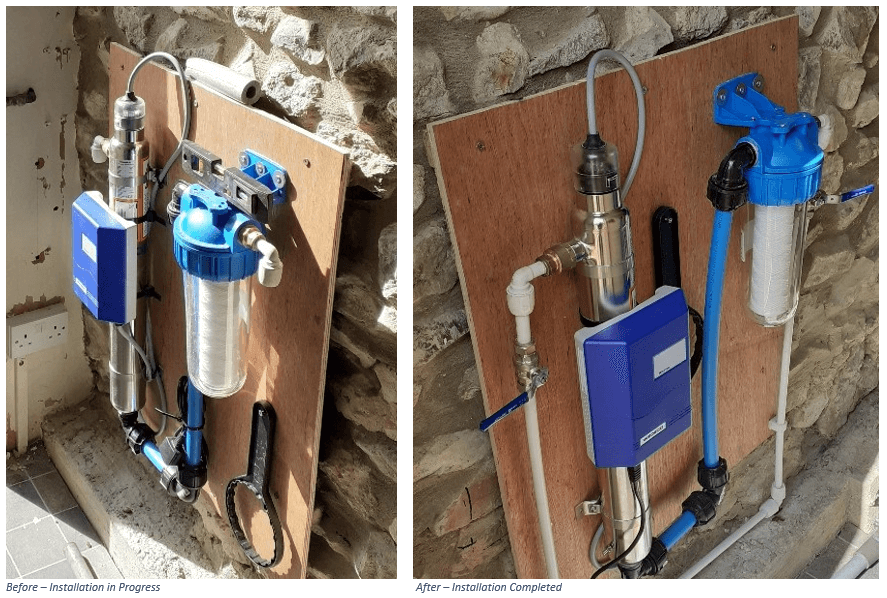
is not obvious to the eye or taste. Ultra Violet Systems can destroy 99.99% of harmful microorganisms that will avoid the use of chemicals or change the odour and taste of your water.

I have never become ill from the water before so why should I have a service?

The quality of water changes daily and, depending on the source, can be affected by variables including surface contamination, flooding, heavy rainfall, drought and snow melt.  Water that was safe yesterday is not guaranteed to be safe tomorrow and there is no easy way to manage the safety of a private water supply without a filtration system in place. Elderly and young children are at the highest risk, as they will not have such a strong immune system, but anyone can be affected.

In fact, many people have commented that after a UV filtration system was installed they have felt less lethargic, and this could be that they have unknowingly been fighting bugs for many years.

What is Ultra Violet Light (UV)?

UV or ultraviolet light is a type of energy found in the electromagnetic spectrum, shining at a specific wavelength.  We are all subject to a small amount of ultraviolet light every time we step into the sunlight. However, it is not visible to the naked eye.

All light is at different wavelengths, for example, a rainbow demonstrates the spectrum of light from red through to blue as each colour shows their individual wavelength.  Ultraviolet is present at the invisible, violet end of the light spectrum.

For over 25 years, UV technology has been used as a safe and trusted, cost-effective process to purify water and eliminate harmful micro-organisms by the water industry, bottled water manufacturers, and homeowners.

How often should I service my Ultra Violet Filtration System?

An ultraviolet lamp will remain effective for between six – twelve months depending upon the water quality. The light will continue to operate long after this period but will not generate the required intensity of UV light. We normally recommend a service every 12 months, to include a sediment filter element and lamp change, to ensure that water quality is maintained within safe limits.

Need a Hand?

For any other help or information give one of our branches a call today on 0117 954 8030, or fill out a contact form and one of our expert team will get back to you.